



New Delhi, March 15 (UNI) The Election Commission on Sunday announced the schedule for Assembly elections in Assam, Kerala, Tamil Nadu, West Bengal and the union Territory of Puducherry, setting the stage for the first major round of state elections after the 2025 Assembly polls in Bihar. The poll panel said voting will be conducted over April in different phases, with the counting of votes for all states and the union Territory scheduled for May 4.
According to the schedule, polling will be held in a single phase in Assam, Kerala and Puducherry on April 9, while elections in Tamil Nadu will be conducted on April 23. West Bengal will go to the polls in two phases on April 23 and April 29.
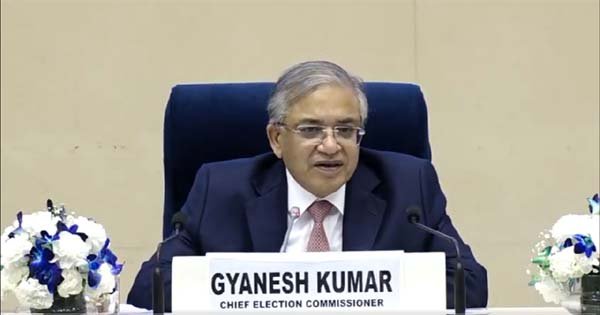
Announcing the dates at a press conference, Chief Election Commissioner Gyanesh Kumar said the Commission had completed extensive consultations and preparations to ensure a smooth, transparent and inclusive electoral process.
“We are fully prepared to conduct free, fair and peaceful elections across these states and the union Territory. All necessary arrangements have been made in consultation with state authorities and security agencies,” Kumar said.
In West Bengal, voting in the first phase will be held on April 23 for 152 Assembly constituencies, while the remaining 142 seats will vote in the second phase on April 29.
The notification for the first phase will be issued on March 30, with April 6 as the last date for filing nominations. Scrutiny of nominations will take place on April 7, and the last date for withdrawal of candidature will be April 9. For the second phase, the notification will be issued on April 2, with April 9 as the last date for nominations. Scrutiny will be held on April 10 and candidates will be able to withdraw their nominations until April 13.
For Tamil Nadu, the notification for elections will be issued on March 30, with the last date for filing nominations on April 6. Scrutiny of nominations will take place on April 7 and the last date for withdrawal will be April 9 before polling on April 23.
For Assam, Kerala and the UT of Puducherry, which are going to booths together on April 9, the election process will begin earlier, with the notification scheduled for March 16. The last date for filing nominations will be March 23, followed by scrutiny on March 24 and the final date for withdrawal on March 26. Polling will take place on April 9.
The Chief Election Commissioner said the Model Code of Conduct had come into immediate effect in all poll-bound states and the union Territory following the announcement of the election schedule. “The Model Code of Conduct is effective from this moment. We expect all political parties and candidates to adhere strictly to the guidelines to maintain the integrity of the democratic process,” Kumar said.
The upcoming elections are expected to carry significant political implications at the national level as they represent the first major electoral test for political parties after the Bihar Assembly elections. Several national and regional parties are preparing for intense campaigns across the five regions.
Among the states going to the polls, West Bengal is expected to witness one of the most closely watched contests. The state will see a high-stakes political battle with three-time Chief Minister Mamata Banerjee seeking another term in office while facing a strong challenge from the Bharatiya Janata Party, which has significantly expanded its presence in the state over the past decade.
Political analysts say the contest in the eastern state is likely to be intense, with both sides mobilising large-scale campaigns and high-profile leaders. The BJP has been working to consolidate its support base after emerging as a major opposition force in the previous Assembly election, while Banerjee’s All India Trinamool Congress is seeking to retain its dominance in the state.
In Assam, the BJP is campaigning aggressively to retain power in the northeastern state it has governed since 2016. The party is expected to highlight its governance record and development initiatives as it seeks a renewed mandate from voters.
Meanwhile, in Kerala and Tamil Nadu, traditional political rivalries are expected to dominate the campaign. Kerala’s election will likely see another contest between the ruling Communist Party of India (Marxist)-led Left Democratic Front and the opposition Indian National Congress-led United Democratic Front.
In Tamil Nadu, regional parties are expected to lead the contest, with national parties playing supporting roles in alliances.
The union Territory of Puducherry, a small coastal territory, has often witnessed competitive contests among regional and national parties due to its unique political dynamics.
The Election Commission said it would deploy central security forces and implement strict monitoring mechanisms to ensure peaceful polling in all regions. “Security arrangements have been carefully planned. Adequate deployment of central forces will be ensured wherever necessary to maintain law and order,” Kumar said.
He also highlighted measures aimed at increasing voter participation and transparency, including enhanced voter awareness programmes and the use of technology for monitoring the electoral process. “Our focus is on ensuring maximum voter participation while maintaining the highest standards of electoral integrity,” he said.
In order to ensure transparency of the process, the CEC said that 100 per cent of the polling stations (approx 2.18 lakh) will have webcasting facility to ensure 17.4 crore electorates participate in the democratic process enthusiastically with pride and responsibility.
With the announcement of the election schedule, political parties are expected to intensify their campaign efforts across the poll-bound states and the union Territory, setting the stage for weeks of intense political activity leading up to polling in April.