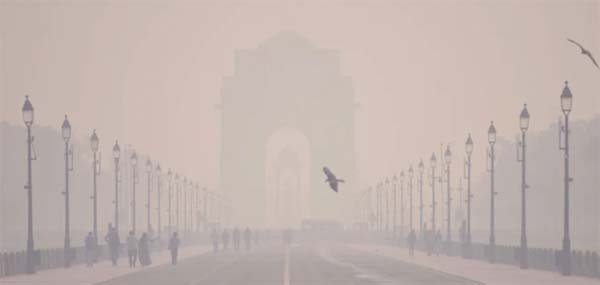






New Delhi, Dec 18 (UNI) Major parts of the national capital were enveloped in a dense layer of toxic smog on Thursday morning, sharply reducing visibility and causing widespread discomfort among residents.
Visuals from key locations including India Gate, AIIMS, Akshardham, ITO and the Barapullah Flyover showed severely reduced visibility as pollution levels spiked across the city.
According to data from the Central Pollution Control Board (CPCB), air quality varied from very poor to severe in different parts of Delhi.
India Gate recorded an AQI of 344 (Very Poor), AIIMS area saw an AQI of 273 (Poor), Akshardham reported a Severe AQI of 416, ITO recorded 398 (Very Poor) and Barapullah Flyover recorded an AQI of 356 (Very Poor).
Areas such as RK Puram remained shrouded in thick smog, recording an Air Quality Index (AQI) of 374, placing it in the very poor category.
The Jawaharlal Nehru Stadium area also witnessed severe pollution levels, with an AQI of 349, categorised as very poor.
In Najafgarh, the AQI was comparatively lower at 284, falling in the poor category, though the area continued to remain under a blanket of toxic smog.
In response to the deteriorating air quality, the Commission for Air Quality Management (CAQM) has invoked all measures under GRAP Stage-IV across Delhi-NCR to curb pollution levels.
As per AQI categorisation, values between 0–50 are considered good, 51–100 satisfactory, 101–200 moderate, 201–300 poor, 301–400 very poor, and 401–500 severe.
Meanwhile, yesterday Delhi’s overall AQI stood at 329 at 6:05 am, based on data from 39 out of 40 monitoring stations, placing the city firmly in the ‘Very Poor’ category.
Earlier, on December 12, the CAQM deployed 19 inspection teams to carry out a large-scale road inspection drive across Delhi as part of its ongoing monitoring and enforcement under the statutory provisions of the Graded Response Action Plan (GRAP).
Health advisories have warned that prolonged exposure to such air quality may cause respiratory discomfort, especially among children, the elderly, and individuals with pre-existing health conditions.
Dense toxic smog chokes Delhi; GRAP-IV enforced as AQI remains ‘Very Poor’ to ‘Severe’