






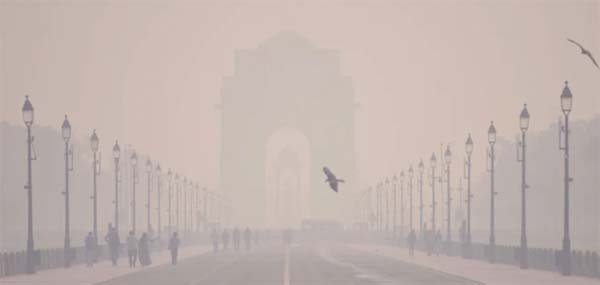
New Delhi, Jan 5 (UNI) Delhi woke up to a dense layer of fog on Monday morning, with air quality across the national capital remaining in the ‘poor’ to ‘very poor’ categories, disrupting flight operations at the Indira Gandhi International (IGI) Airport.
According to the Central Pollution Control Board (CPCB), Delhi’s overall Air Quality Index (AQI) stood at 260–262 by 8 am, remaining firmly in the ‘poor’ category for a second consecutive day.
Several areas recorded worrying pollution levels. Akshardham reported an AQI of 294, while ITO recorded 253–256, both in the ‘poor’ category. Anand Vihar saw a sharper deterioration, with an AQI of 320, placing it in the ‘very poor’ bracket. Chandni Chowk was among the worst-affected areas, registering an AQI of 337.
Other locations such as Alipur (275), Burari (216), Dwarka Sector 8 (288) and Mundka (281) also remained in the ‘poor’ category. Meanwhile, stations including Aya Nagar (178), Bawana (195), IGI Airport (153), IIT Delhi (192), Lodhi Road (182) and NSIT Dwarka (171) recorded ‘moderate’ air quality levels.
The dense fog and smog reduced visibility during the early hours, leading to delays of several flights at IGI Airport. Authorities advised passengers to check flight schedules before travelling.
Meteorological conditions typical of winter, low temperatures, calm winds and high humidity, have trapped pollutants close to the surface, prolonging poor air quality. Health experts warn that the persistent haze poses increased risks to children, the elderly and people with respiratory conditions.
Meanwhile, the Sub-Committee on the Graded Response Action Plan (GRAP) under the Commission for Air Quality Management (CAQM) for the NCR and adjoining areas revoked Stage III restrictions on Friday evening, citing a marked improvement in air quality driven by favourable meteorological conditions.
However, authorities urged residents to strictly adhere to the measures prescribed under Stages I and II of the existing GRAP framework to prevent any further deterioration in air quality. The government also clarified that construction and demolition sites facing closure orders for violations or non-compliance with statutory norms will not be permitted to resume operations without explicit approval from the Commission.