



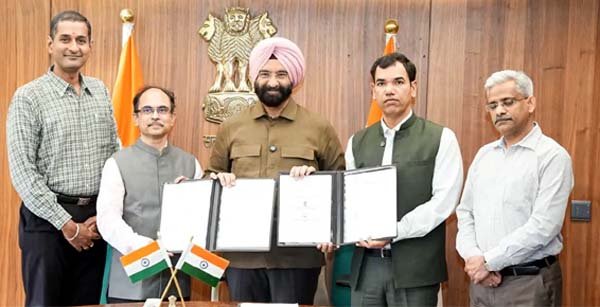
New Delhi, March 13 (UNI) Delhi government on Friday signed a Memorandum of Understanding with Indian Institute of Technology Madras to undertake a comprehensive pilot study on photocatalytic “smog-eating” surfaces aimed at reducing key air pollutants in the national capital.
The project, titled ‘Comprehensive Study on the Effectiveness of Photocatalytic Smog-Eating Surfaces, Specifically Utilizing Titanium Dioxide (TiO₂) or Similar Safe Photocatalysts for Abatement of Air Pollution in Delhi’ will examine the potential of advanced materials to break down pollutants such as nitrogen dioxide (NO₂) and volatile organic compounds (VOCs), which contribute significantly to urban smog.
The MoU was signed in the presence of Delhi Environment Minister Manjinder Singh Sirsa and Professor Somnath C. Roy from the Department of Physics at IIT Madras, who will serve as the Principal Investigator for the project.
Senior officials from the Delhi government’s environment department and the Delhi Pollution Control Committee (DPCC) were also present.
Speaking on the occasion, Sirsa said the collaboration aims to identify durable and affordable ways to deploy “smog-eating” coatings on city infrastructure such as roads, buildings and other surfaces.
“Through this IIT Madras study, we aim to find the best, long-lasting and affordable ways to apply smog-eating coatings across urban surfaces. If evidence shows these materials can significantly reduce NO₂ and other pollutants, it can become a powerful tool in our fight against air pollution,” he said.
The minister said Delhi’s rapidly growing population and expanding infrastructure require scientific solutions that can improve air quality without restricting development.
Photocatalytic materials such as titanium dioxide become active under sunlight and trigger chemical reactions that convert harmful pollutants into less harmful compounds.
The six-month study will assess various methods of integrating such materials into urban infrastructure, including mixing them with concrete and asphalt, applying them as surface coatings, and installing specialised panels on rooftops or street-light poles.
Researchers will also examine the feasibility of pollutant-removal panels made using titanium dioxide-based materials, which could function similarly to solar panels by capturing and neutralising pollutants directly from ambient air.
Highlighting the research methodology, Prof Somnath Roy said the project will begin with controlled laboratory experiments before moving to field trials in Delhi.
“The study will start with lab testing in a smog chamber at IIT Madras to accurately measure pollutant abatement. This will be followed by real-time field assessments in Delhi on surfaces such as concrete, asphalt, metal panels, glass and roads to evaluate durability and efficiency under actual urban conditions,” he said.
Subject to the study’s findings, the government may explore deploying photocatalytic surfaces during peak smog months later this year as a scalable and cost-effective intervention to improve air quality in the city.


