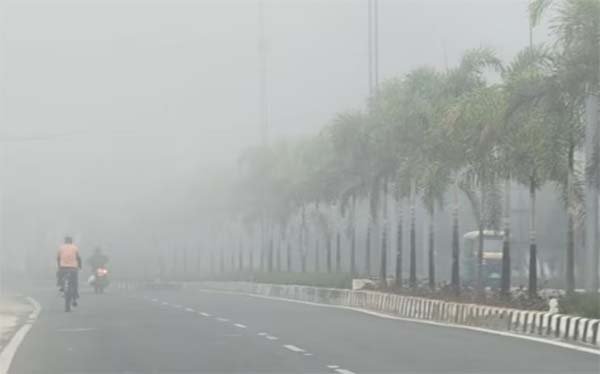






New Delhi, Feb 10 (UNI) Delhi witnessed a further decline in air quality on Tuesday, with the overall Air Quality Index (AQI) rising to 267, placing it firmly in the ‘poor’ category.
A visible layer of smog covered several parts of the city, while areas such as Anand Vihar, Bawana, and Narela reported ‘very poor’ air quality, raising fresh health concerns.
According to data from the Central Pollution Control Board (CPCB), the AQI on Tuesday morning was significantly higher than Monday’s reading of 206, which also fell under the ‘poor’ category. At around 7 am, Delhi’s average AQI stood at 267. Among the worst-affected locations, Anand Vihar recorded an AQI of 317, while Bawana registered 333, making them the most polluted zones in the capital.
Residents of Delhi, Noida, Gurugram, and nearby areas are also experiencing a noticeable shift in weather patterns, with unseasonal warmth being felt in early February itself. On Monday, February 9, the maximum temperature crossed 26 degrees Celsius, while the minimum settled at 11 degrees Celsius. The Meteorological Department has indicated that temperatures are expected to rise further in the coming days. CPCB officials attributed the worsening pollution levels largely to weak wind speeds in the region.
For February 10, the maximum temperature is likely to hover around 25 degrees Celsius, while the minimum may dip to nearly 10 degrees Celsius. Mist is expected to prevail. Weather conditions are forecast to remain largely unchanged from February 11 to 15, with occasional partial cloud cover and morning fog during this period.
During these days, the maximum temperature is expected to range between 22 and 27 degrees Celsius, while the minimum temperature may stay between 10 and 13 degrees Celsius.
Delhi air quality deteriorates further; AQI hits 267, smog engulfs city