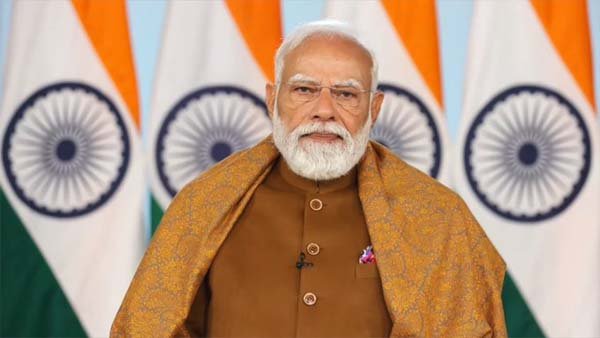

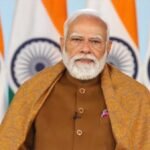
New Delhi, Dec 5 (UNI) Russian President Vladimir Putin on Friday thanked Prime Minister Narendra Modi for inviting him to India during their bilateral talks.
“Dear Prime Minister, dear friends, first of all, thank you very much for the invitation and for yesterday’s very good evening,” Putin said during a meeting with Modi.
Emphasizing Russia’s commitment to peace on Ukraine issue,
Putin expressed confidence that the ongoing working day in India would yield positive results.
He highlighted the deep-rooted relations between Russia and India and appreciated Modi’s efforts to help resolve the Ukrainian issue.
Putin also informed Modi about Russia and the US’s actions regarding a possible peaceful settlement, underscoring his focus on diplomacy and dialogue.
Putin’s trip, his first to India since the start of the Ukraine war, comes as both nations navigate an increasingly complex geopolitical landscape: Russia under the weight of Western sanctions tied to its war in Ukraine, and India balancing its historic ties with Moscow while working to maintain stronger ties with Washington.
India, as the largest buyer of Russian weapons and energy imports, remains a crucial partner for the Kremlin.
For New Delhi, Moscow has long been a dependable source of defence technology and, more recently, discounted crude that has helped cushion domestic inflation. But the war has complicated the relationship, drawing scrutiny from European allies whose own dealings, including in energy purchases, with Moscow have quietly continued whenever convenient.
Modi welcomed Putin on a red carpet at an airport outside the capital, later hosting him for a private dinner at his residence, in an armoured Toyota Fortuner, with the Russian President’s custom-built Aurus Senat limousine in which the two rode together at the SCO meet in China.
The display of political warmth came even as New Delhi negotiates a potential trade deal with the United States aimed at rolling back punitive tariffs imposed by the Trump administration to punish India’s ballooning imports of Russian oil.
Russia is now supplying more than a third of India’s crude imports, up from about 2.5 percent before the war. However, since Washington’s trade measures were announced. Indian refiners have quietly worked to diversify suppliers.
The Kremlin is nevertheless pushing for deeper economic integration. Russian officials have publicly floated the goal of lifting bilateral trade to $100 billion by 2030, and officials said that moves are afoot for a Free Trade Agreement with the Eurasian Economic union (EAEU).
Putin has signalled he wants India to export more goods to Russia to stabilise the relationship. Accompanying the Russian leader is a high-ranking business and government delegation, including Defense Minister Andrei Belousov, who met Indian Defense Minister Rajnath Singh on Thursday.
India’s Defense Ministry said Belousov offered expanded cooperation aimed at helping India achieve greater self-reliance in defence manufacturing, a long-standing goal of the Modi government.
Russia continues to view India as a central market for its defense industry, with ongoing deals for S-400 air-defense systems, next-generation Sukhoi-57 fighter jets, and even small modular nuclear reactors. India remains the world’s largest buyer of Russian arms, a fact that both countries point to as evidence of trust built over decades.
The summit will also address the growing movement of Indian workers to Russia, an issue that has gained prominence as the Kremlin seeks labour to offset wartime shortages and India tries to expand overseas employment opportunities.
Confident today’s working day in India will bring positive outcomes: Putin