





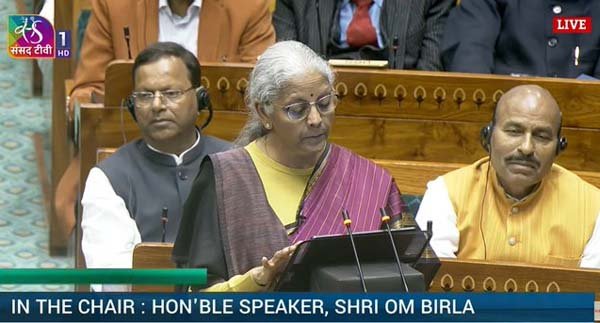
New Delhi, Feb 1 (UNI) union Finance Minister Nirmala Sitharaman on Sunday unveiled an ambitious, manufacturing-led growth roadmap in the union Budget 2026–27, announcing the development of seven high-speed corridors, a renewed focus on economic cities, and a series of measures aimed at boosting self-reliance, jobs and technology leadership.
Presenting the Budget in Lok Sabha, Sitharaman said the government’s core strategy continues to be anchored in Aatmanirbharta, with large-scale public investment and structural reforms driving growth. “Keeping Aatmanirbharta as a lodestar, we have built domestic manufacturing capacity, energy security and reduced critical import dependencies,” she said.
Making a major infrastructure announcement, the Finance Minister said the government will build seven high-speed corridors as part of its plan to accelerate logistics, manufacturing and regional development. “The main focus is to develop economic cities,” Sitharaman said, underlining the government’s intent to cluster industry, infrastructure and urbanisation for faster growth.
The Budget also proposes a Rare Earth Corridor connecting Odisha, Kerala and Tamil Nadu, along with three mineral parks to be developed on challenge mode, aimed at strengthening India’s strategic minerals and clean-tech supply chains.
To “accelerate and sustain economic growth,” Sitharaman said the government will scale up manufacturing across seven strategic sectors, though detailed sector-wise allocations are expected later. Emphasising India’s reform track record, she said, “Since the Prime Minister’s address from the Red Fort this year, over 350 economic reforms have been implemented.”
The Finance Minister announced the launch of India Semiconductor Mission 2.0, with a strong focus on industry-led research and training centres to build a future-ready technology workforce. “We will focus on developing tech capabilities and skilled manpower through closer industry participation,” she said.
In a move to boost tourism and regional connectivity, the Budget proposes incentives for indigenous manufacturing of seaplanes. Sitharaman also announced mega textile parks in challenge mode and the launch of the Mahatma Gandhi Gram Swaraj Initiative to promote Khadi and handloom in rural villages.
“I propose to launch the Mahatma Gandhi Gram Swaraj initiative to strengthen Khadi and handloom,” the Finance Minister said, positioning traditional sectors as engines of inclusive rural growth.
Small and medium enterprises (SMEs) received significant attention in the Budget. Sitharaman proposed a Rs 10,000 crore allocation to the Self-Reliant India Fund for SMEs and announced a new Corporate Mitra programme aimed at professional development, mentorship and market access for smaller businesses.
Defending the government’s economic record, Sitharaman said India’s growth story has been underpinned by fiscal discipline and policy consistency. “Since we assumed office 12 years ago, the country’s economic trajectory has been marked by stability, fiscal discipline, sustained growth and moderate inflation,” she said.
She added that reforms undertaken over the years have ensured that citizens directly benefit from government action. “We have ensured that citizens benefit from every action of the Government, undertaking reforms to support employment generation, agricultural productivity, household purchasing power and universal services,” she said.
According to the Finance Minister, these measures have helped India achieve around 7% GDP growth, alongside “substantial strides in poverty reduction and improvement in the lives of our people.”
With a strong emphasis on infrastructure, manufacturing, technology and MSMEs, Budget 2026–27 signals the government’s intent to position India as a resilient, self-reliant and globally competitive economy, while keeping inclusive growth at the core of its policy agenda.