




New Delhi Dec 16 (UNI) The Viksit Bharat- Guarantee for Rozgar and Ajeevika Mission (Gramin), abbreviated as VB–G RAM G (विकसित भारत – जी राम जी) Bill, 2025, intending to revamp rural employment scheme was introduced in Lok Sabha on Tuesday amid strong objections from opposition parties.
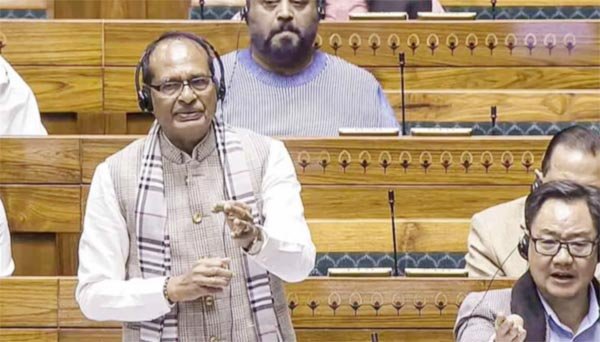
The Bill was moved for introduction by union Minister of Rural Development Shivraj Singh Chouhan.
The VB – G RAM G Bill is designed to overhaul and strengthen the existing Mahatma Gandhi National Rural Employment Guarantee Act (MGNREGA), a flagship social welfare programme that guarantees wage employment to rural households.
This new legislation guarantees 125 days of wage employment annually to rural families, emphasizing empowerment, development, convergence, and saturation of government schemes to maximize impact. The bill also proposes to change the funding structure, with states bearing 40 percent of the costs.
A key feature of the Bill is the preparation of a ‘Vikasit Gram Panchayat Plan’ by Gram Panchayats. These plans will be based on the principles of convergence and saturation of various schemes, coordinated through the PM Gati Shakti initiative, aimed at accelerating infrastructure development and service delivery at the grassroots level.
The Bill envisions the creation of an integrated ‘Vikasit Bharat National Rural Infrastructure Stack’ to manage and implement rural public works efficiently.
It places special focus on critical areas such as water security, core rural infrastructure, livelihood opportunities, and disaster-resilient projects. To support agricultural activity, the Bill also includes special provisions to ensure the availability of farm labour during peak farming seasons.
Transparency and accountability are central to the Bill’s framework, with a weekly public disclosure system and robust social audits mandated to monitor implementation. The governance structure relies heavily on digital public infrastructure to ensure high-integrity and efficient delivery of services.
However, the Bill has faced sharp criticism from opposition parties. They have collectively demanded that the government refer the legislation to a Standing Committee of Parliament for thorough examination, emphasizing the sensitive nature of reforms to a programme that serves as a crucial social safety net for millions of rural Indians.
Congress General Secretary Jairam Ramesh was among the prominent voices calling for detailed scrutiny of the Bill. Senior Congress leader Priyanka Gandhi said the new bill weakens the law and should be withdrawn. “No law should be passed based on someone’s “whim, ambition and prejudice,” she insisyed.
The Congress also staged a protest in Parliament premises, waving photographs of Mahatma Gandhi, after whom the MGNREGA is named.
The introduction of the VB- G RAM G Bill follows an earlier attempt on Monday when the government listed it for introduction in the supplementary business of the Lok Sabha but decided not to proceed, highlighting the political sensitivity and potential for heated debate.
By relisting and introducing the Bill, the government has signaled its readiness to engage with parliamentary debate despite the opposition’s united stand for a comprehensive review before enacting any legislative changes. The Bill’s fate is likely to remain a focal point of political discussion in the sessions ahead, given its wide-reaching implications for rural employment and livelihoods in India. UNI SKA AAB
Bill to revamp rural employment scheme introduced in Lok Sabha amid Opposition protests