






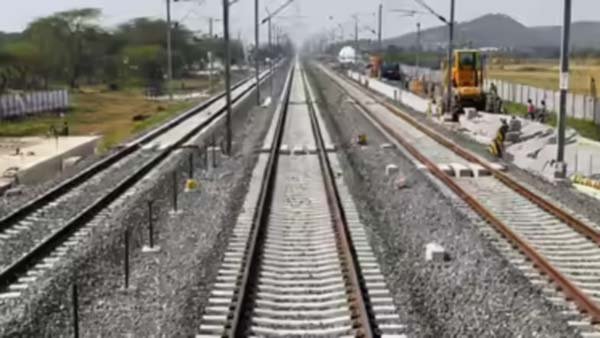
New Delhi, 9 Feb (UNI) Indian Railways has cleared a series of major infrastructure projects across multiple states aimed at boosting network capacity, improving safety, and enhancing overall operational efficiency.
The approved works include new line doublings, additional tracks on high-density corridors, station safety upgrades, and strategic bypass lines designed to ease congestion and streamline freight and passenger movement.
Key initiatives span mineral and industrial routes in Jharkhand, critical passenger and freight corridors in Kerala and Tamil Nadu, and decongestion measures in Punjab and Haryana, alongside the rollout of advanced electronic interlocking systems at dozens of stations under Northern Railway.
Detailing the projects, the Ministry of Railways said that Barbenda–Damrughutu Doubling and Damrughutu–Bokaro Steel City 3rd and 4th Lines in Jharkhand are major capacity expansion projects under South Eastern Railway and a cornerstone of India’s Energy, Mineral, and Cement Corridor.
Currently, the line operates at 108 per cent utilisation, with train detention ranging between 90-150 minutes, handling 78 trains daily (38 passenger and 40 freight) and supporting a freight throughput of 35.22 MTPA. Without intervention, utilisation was projected to reach 132% by 2028–29.
The project strengthens connectivity to key industrial and energy hubs, including Central Coalfields, cement and steel plants, Hindustan Petroleum Corporation Limited Depot, Bharat Petroleum Corporation Limited Depot, and the Bokaro Steel City industrial ecosystem.
To further enhance safety and operational efficiency, Indian Railways has approved the implementation of Electronic Interlocking (EI) at 34 stations across Northern Railway routes where Kavach is being rolled out. This includes 21 stations in the Delhi Division at a cost of Rs 292.24 crore and 13 stations in the Ambala Division costing Rs 129.17 crore.
These upgrades will enable faster and safer train operations, improve the reliability of signalling systems, support higher train frequencies on high-density routes, and complement modern train protection systems.
The approval of the Rajpura Bypass Line will significantly enhance capacity and operational efficiency on the Ambala–Jalandhar section, one of the busiest corridors on Northern Railway.
The project will provide direct rail connectivity between the New Shambhu Dedicated Freight Corridor (DFC) station and the Kauli station on the Rajpura–Bathinda line, enabling freight trains to bypass the congested Rajpura Yard.
This will streamline freight movement, ease pressure on existing lines, and support the projected rise in traffic demand, while ensuring smoother integration with the DFC and more reliable passenger and freight operations across the region.
The Alappuzha–Ambalapuzha Doubling (12.66 km) project will remove a critical single-line constraint on the Ernakulam–Turavur–Kayankulam route.
Once completed, it will enable nine additional passenger trains per day in each direction, add 2.88 million tonnes per annum (MTPA) of freight capacity, and generate additional annual earnings of Rs 3.23 crore.
The project will significantly improve operational efficiency by reducing detention for both passenger and freight trains.
By addressing the last remaining single-line stretch on this corridor, it ensures smoother and uninterrupted train movement, enhancing travel reliability for long-distance passengers and strengthening inter-State freight flows within Kerala, while decongesting major junctions for faster, seamless travel.
The Palakkad bypass project provides immediate operational and passenger benefits by eliminating engine reversal at Palakkad Junction in Kerala for multiple train services.
It reduces the average detention of passenger trains by 40-44 minutes and cuts freight detention by up to 120 minutes per train, while also supporting additional passenger services planned from Palakkad Junction.
By streamlining train movements, the bypass will significantly improve punctuality on routes connecting Shoranur, Thiruvananthapuram, and Pollachi, while easing congestion at one of Southern Railway’s busiest junctions.
The Irugur–Podanur Doubling (10.77 km) project is one of the most significant developments for Tamil Nadu is the approval for the doubling of the Irugur–Podanur section, a crucial link on the Chennai–Thiruvananthapuram corridor.
This project will allow the operation of 15 additional passenger trains per day and increase freight capacity by 3.12 million tonnes per annum (MTPA), with annual net earnings expected to rise by Rs 11.77 crore.
Currently, line capacity utilisation stands at 60 per cent but with this expansion, it is projected to reach 131 per cent by 2027–28, highlighting the urgency and strategic importance of the project.
With multiple quadruplication projects already completed or underway on adjoining stretches, the doubling of this section will ensure that the entire Chennai–Coimbatore–Podanur belt transforms into a high-capacity, four-line corridor. This will directly benefit industrial hubs such as Coimbatore, improve terminal operations at Podanur, and support new train services to northern destinations.