





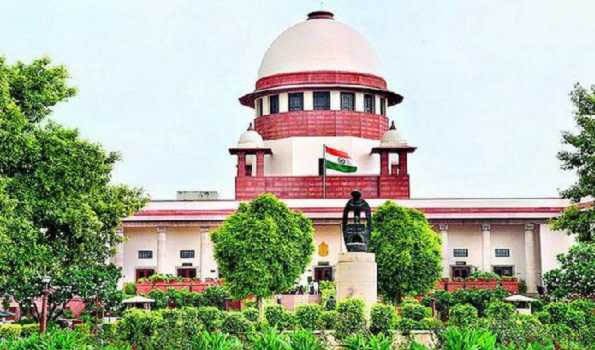
New Delhi, Jan 19 (UNI) The Supreme Court on Monday issued a series of directions to the Election Commission of India (ECI) to ensure that the verification of voters flagged under the “logical discrepancies” category during the Special Intensive Revision (SIR) process in West Bengal is conducted transparently and without causing stress or inconvenience to citizens.
The Court directed the ECI to publish the list of persons who have been issued notices citing “logical discrepancies” in their enumeration forms. These lists are to be displayed at Panchayat Bhavans and Block offices. Noting that approximately 1.25 crore notices have been issued, the Court recorded that discrepancies cited include a mismatch in parents’ names, a low age gap with parents, and cases where the number of children attributed to the same parents exceeds six.
The Court clarified that individuals who have received notices are entitled to submit documents or objections through authorised agents, including Booth Level Agents (BLAs). Such authorisation must be made through a letter bearing the signature or thumb impression of the concerned voter.
Addressing concerns that voters may be required to travel long distances to respond to notices, the court directed that facilities for submission of documents and objections be established within Panchayat Bhavans or Block offices. If the documents are found unsatisfactory, election officials must grant the affected persons an opportunity of hearing, which may also be attended by their authorised agents.
The court further directed that election officials, upon receiving documents or conducting hearings, must certify such receipt or hearing. The state government was asked to ensure adequate manpower support to the ECI, while the Director General of Police, West Bengal, was directed to ensure that no law and order issues arise during the process.
The directions were issued by a Bench comprising Chief Justice of India Surya Kant, Justice Dipankar Datta and Justice Joymalya Bagchi while hearing petitions related to the SIR exercise in West Bengal.
During the hearing, Senior Advocate Kapil Sibal, appearing for certain Trinamool Congress members, submitted that many voters included in the draft electoral rolls had been served notices for hearings on account of minor spelling variations in surnames such as “Ganguly” and “Datta,” as well as alleged low age gaps with parents.
He sought publication of the discrepancies and permission for BLAs to assist voters, stating that many individuals were being asked to travel hundreds of kilometres. Senior Advocate Rakesh Dwivedi, appearing for the ECI, submitted that instructions had been issued not to flag spelling variations as discrepancies.
He stated that cases where the age difference with parents is 15 years or less are treated as “logical discrepancies.” Questioning this classification, Justice Bagchi observed, “How can a 15-year age gap between mother and son be a logical discrepancy?” and noted that child marriages are not unknown in the country.
Dwivedi submitted that BLAs cannot insist on participating in every hearing, as they are members of political parties, but clarified that voters are free to authorise agents of their choice, including BLAs. Senior Advocates Shyam Divan and Kalyan Banerjee supported Sibal’s submissions.
Divan alleged that instructions to Booth Level Officers were being circulated through WhatsApp messages instead of formal orders, raising concerns about transparency. Banerjee alleged that notices had been issued even to Nobel Laureate Professor Amartya Sen and sitting Members of Parliament, suggesting voter profiling.
Refuting the allegations, Dwivedi remarked that if the ECI were to be distrusted, it should not be entrusted with conducting elections at all. Senior Advocate Dama Seshadri Naidu, representing the ECI in a connected matter, submitted that election officials were facing obstructions and threats while performing their duties in the State.
Emphasising the need for balance, the Bench observed that while correction exercises are permissible, they must be carried out transparently and without causing hardship to voters. “Some correction exercises can be taken, but they should be transparent,” the Chief Justice said Highlighting the impact on citizens, Justice Bagchi added, “See the strain and stress on ordinary people over one crore people have been issued notices. Do not create a third issue here.”