





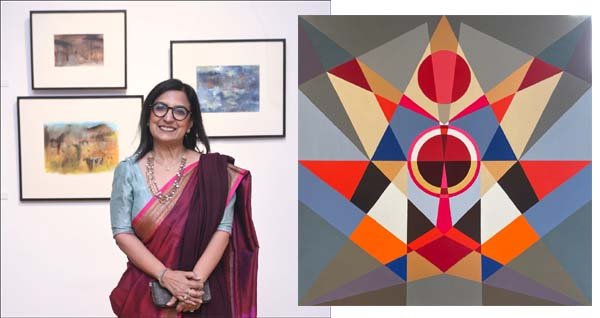
New Delhi: Creative fulfilment in art often develops gradually rather than appearing as a moment of certainty. In the work of Neerja Peters, this fulfilment unfolds quietly through discipline, restraint and a deep engagement with silence. Her artistic journey reflects a mature stage where process, intention and expression come together in a balanced harmony.
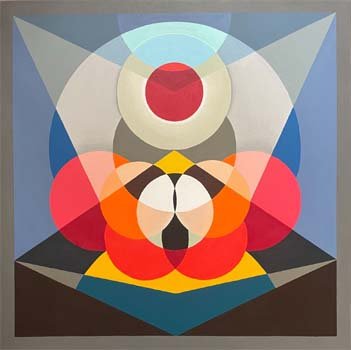
Over the years, Peters has explored a variety of artistic forms, mediums and genres. Her early work, rooted in realism, helped shape her sharp observation and technical precision. With time, she moved towards experimentation, gradually refining her visual language. In her mature works, geometry plays a central role. Elements such as grids, axes and horizons create structure and stability, allowing the compositions to breathe within carefully defined boundaries. Within this order, Peters finds a sense of creative freedom.
Restraint and clarity are key features of her current practice. Rather than pursuing complexity, Peters emphasises simplicity and balance. Each composition appears thoughtful and deliberate, reflecting an intuitive understanding of when a work has reached completion. This shift signals an evolution from exploration to inner confidence in her visual vocabulary.
Colour is another important aspect of her artistic expression. Peters draws inspiration from the spiritual experience of dawn, particularly the pre-sunrise period known in Indian philosophy as Brahma Muhurat or Amrit Vela. Instead of literally depicting dawn, she interprets its qualities the gentle emergence of light, the fading of darkness and the sense of quiet potential within stillness. These subtle colour transitions create an atmosphere of awakening rather than spectacle.
A distinctive feature of Peters work is her use of asemic writing abstract inscriptions that resemble ancient scripts, tantric diagrams or cosmological charts. These markings are not meant to be read but to be experienced. Repeated rhythmically across the surface, they function like visual mantras, transforming the act of painting into a meditative and devotional practice.
Motifs such as bird-like forms and linear sequences also appear across her compositions, suggesting movement and transformation while maintaining a quiet presence. The subtlety of these elements reinforces the contemplative nature of her art.
Equally significant is Peters’ relationship with time. Her creative process is slow, immersive and rooted in repetition. In contrast to the fast-paced contemporary art environment, her work embraces stillness and attentive making. Through this process, Peters experiences a state of inner joy ananda where the act of creation itself becomes the source of fulfilment.
Rather than aiming to impress or persuade, Neerja Peters’ art invites contemplation. Through geometry, light and silence, she has arrived at a creative space defined not by achievement, but by inner alignment and tranquillity.