


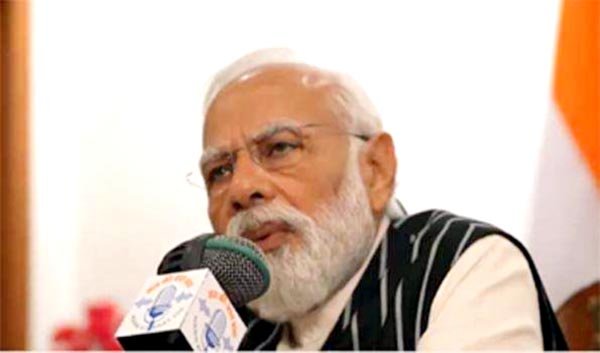
New Delhi, Feb 22 (UNI) Calling the recently held India AI Impact Summit a “turning point for the world,” Prime Minister Narendra Modi on Sunday highlighted how artificial intelligence is transforming healthcare, agriculture and the preservation of India’s ancient knowledge, while also touching on sports, organ donation, financial safety and cultural revival during the 131st episode of his monthly radio programme, Mann Ki Baat.
Addressing the nation, the Prime Minister said the Global AI Impact Summit in Delhi marked a defining moment in how the world will use the power of artificial intelligence in the future.
“This summit proved to be a turning point in the trajectory of how the world will utilize the power of AI,” he said, adding that leaders, technology CEOs, start-up innovators and youth participants witnessed India’s growing capabilities in the sector.
Modi said world leaders were particularly impressed by two AI-driven innovations showcased at the summit.
“The first product was at Amul’s booth. It explained how AI is helping us in the treatment of animals and how farmers keep track of their dairy and animals with the help of 24×7 AI assistance,” he said.
The second innovation focused on preserving India’s cultural heritage. Modi described how ancient manuscripts are being digitised, enhanced for readability, converted into machine-readable text and even narrated by AI avatars in multiple languages.
Referring to the ancient medical text Sushrut Samhita, he said, “World leaders were amazed to see how, with the help of AI, we are preserving our ancient texts, our ancient knowledge and adapting them for today’s generation.”
He added that India launched three “Made in India” AI models during the summit, underscoring the country’s technological momentum.
Switching to sports, the Prime Minister spoke about the ongoing ICC Men’s T20 World Cup, noting the growing presence of players of Indian origin in international teams.
“The jersey may be of another country, but on hearing the name, you feel that the person is from our country. Then a slight joy arises in some corner of the heart,” he said.
He pointed out that quite a few teams have several players of Indian origin and mentioned USA team captain Monank Patel, who previously played domestic cricket in Gujarat. Players of Indian origin are also representing teams such as Oman, New Zealand, UAE and Italy.
“This is the hallmark of Indianness. Wherever Indians go, they remain connected to their roots and contribute wholeheartedly to their karmabhoomi,” Modi said.
In an emotional segment, Modi spoke about 10-month-old Aalin Sherin Abraham from Kerala, who passed away recently. Despite their grief, her parents chose to donate her organs.
“There is no greater sorrow for any parent than losing one’s own child. But even amidst such profound pain, her parents made a decision that has filled the heart of every citizen with respect,” he said.
He noted that awareness around organ donation is steadily rising in India and cited examples of transplant recipients who have gone on to lead active lives, including undertaking pilgrimages and excelling in sports.
“This proves once again that a single noble act can change the lives of countless people,” he said.
Marking a symbolic shift away from colonial-era legacies, Modi announced that a statue of C Rajagopalachari would be unveiled at Rashtrapati Bhavan on February 23 during ‘Rajaji Utsav’.
Rajagopalachari, independent India’s first Governor-General, “saw power not as a position but as a service,” Modi said. He added that a statue of British architect Edwin Lutyens, which stood at Rashtrapati Bhavan, would be replaced.
“Unfortunately, even after independence, statues of British administrators were allowed to remain… but those of the nation’s greatest sons were denied space,” he said.
The Prime Minister also cautioned citizens against rising incidents of digital fraud and “digital arrest” scams. He stressed the importance of updating KYC (Know Your Customer) details only through official banking channels.
“Correct KYC, timely re-KYC keeps your account safe,” he said, urging people not to share OTPs, Aadhaar numbers or bank details with unknown callers.
He also referenced the Reserve Bank of India’s Financial Literacy Week campaign and called for greater vigilance.
Modi praised farmers for moving beyond production to focus on quality, value addition and new markets. He cited examples from Odisha and Kerala, including integrated farming models and the cultivation of 570 varieties of rice in a single field in Thrissur district.
“Today, India has become the world’s largest rice producer. Producing over 150 million tonnes of rice is no small achievement,” he said.
He also highlighted GI-tagged exports such as Nanjangud bananas and Mysuru betel leaves reaching international markets.
Drawing parallels with the Maha Kumbh, Modi spoke about the revival of the centuries-old Mamangam tradition at Tirunavaya in Kerala, often called the Kerala Kumbh.
“For nearly 250 years, this event had not been celebrated with the same grandeur. But today, as India re-recognizes its heritage, history has taken another turn,” he said, describing it as a cultural reawakening.
On the eve of her birth anniversary, Modi paid tributes to former Tamil Nadu Chief Minister J Jayalalithaa, recalling her commitment to welfare, governance and patriotism.
He also addressed students appearing for examinations, referencing his interaction programme Pariksha Pe Charcha.
“Your worth isn’t determined by your mark sheet. Trust yourself,” he told students, urging them not to let stress dominate their preparation.
With Ramzan underway and Holi approaching, Modi extended festive greetings and reiterated his call for adopting swadeshi products during celebrations.
“When you buy swadeshi, you also help in the campaign to make the country self-reliant,” he said.