





Sangeeta Sharma
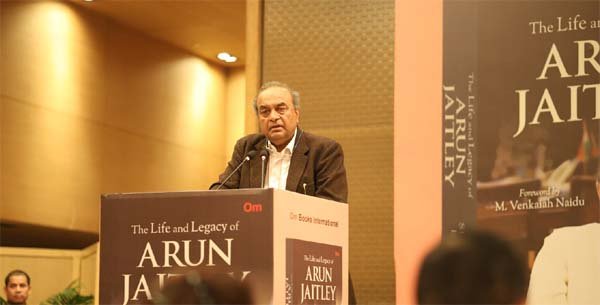
New Delhi, Jan 22 (UNI) “A true leader and a master problem-solver,” said former Vice President M Venkaiah Naidu, as he paid tribute to the late Arun Jaitley during the launch of the biography The Life and Legacy of Arun Jaitley.
While speaking at the event, Naidu reminisced about Jaitley’s remarkable political acumen, recalling how party members regularly turned to him for guidance on complex economic and constitutional issues.
Naidu highlighted Jaitley’s critical role in shaping key reforms as he shared an incident in which Jaitley helped build consensus for the landmark Goods and Services Tax (GST) Bill by facilitating a meeting between Naidu and Congress leader Sonia Gandhi.
This moment, Naidu reflected, encapsulated Jaitley’s unique ability to bridge divides and navigate through political challenges with ease.
A distinguished gathering of political leaders, judges, senior advocates, civil servants and close associates gathered to pay tribute to the life, values and enduring legacy of the late Minister Arun Jaitley.
The book, authored by advocate Sumant Batra, was released by former Vice-President of India M. Venkaiah Naidu, the Chief Guest at the event.
The ceremony was attended by Jaitley’s family members, including his wife Sangeeta Jaitley, son Rohan Jaitley and daughter Sonali Jaitley, along with an impressive array of legal luminaries, judges and political figures cutting across party lines.
Among those present were former Supreme Court judges Justice A K Sikri, Justice Arun Mishra, Justice Hemant Gupta, Delhi High Court judge Justice Pratibha M. Singh, senior advocate and Congress leader Abhishek Manu Singhvi, former Additional Solicitors General A.S. Chandhiok and Maninder Singh, Former Attorney General Mukul Rohatgi, and former G20 Sherpa Amitabh Kant, among many others.
Releasing the book, Venkaiah Naidu described Arun Jaitley as “a great friend, philosopher and guide,” recalling their shared journey from student politics in the 1970s as ABVP representatives to senior roles in party and government. “We were both incarcerated during the Emergency. Over decades, we worked closely together, bound by trust, mutual respect and shared ideological convictions,” Naidu said. He noted that the book was compelling because it honestly captured the many facets of Jaitley’s personality and the different phases of his public life.
Lamenting the decline in civility in contemporary politics, Naidu said, “We need ideal politicians to be remembered, respected and followed. We are not enemies; we are only political rivals.” Urging young people to read the book, he said Jaitley’s life offered enduring lessons on how consensus could be built across party lines. He described Jaitley as a brilliant lawyer, a persuasive orator and a parliamentarian respected across ideologies.
Senior advocate Abhishek Manu Singhvi remembered Jaitley as a “gentleman in politics” and a “quintessential Central Hall man,” whose presence symbolised an era of dialogue and camaraderie in Parliament.
Recalling their courtroom and parliamentary battles sometimes on the same day, Singhvi said their rivalry was always marked by dignity and warmth.
He said Jaitley’s wit was matched by his formidable command over complex constitutional and political issues, including his legendary impromptu interventions on Jammu and Kashmir.
He also recalled Jaitley being described by columnist Suhel Seth as the “Amol Palekar of Indian politics”, understated, effective and deeply respected.
Justice A K Sikri traced his association with Jaitley back to their days at Shri Ram College of Commerce, recalling how a speech delivered by Jaitley left him “awed” by its clarity and persuasion.
Detention during the Emergency, Justice Sikri said, proved to be a defining life lesson that made Jaitley stronger and more resolute.
He spoke of Jaitley’s exceptional time management, compassion for colleagues and staff, and his quiet but powerful mentorship of young professionals. “If he saw a spark in a young person, he would immediately hold his hand and help him rise,” Justice Sikri said, citing Sumant Batra’s professional journey as a prime example.
Several speakers recalled Jaitley’s extraordinary generosity and humaneness beyond the public gaze. The Delhi High Court canteen, it was said, often turned into an informal classroom, with 50 to 60 young lawyers gathered around Jaitley at a table meant for ten, listening as he discussed law, politics and life.
He took personal care of his staff, setting up a welfare fund, ensuring housing security and the best possible education for their children, acts that reflected his belief that leadership carried moral responsibility.
Jaitley’s approachability was another recurring theme. Journalists remembered him as one of the most media-friendly politicians of his time, someone who believed that a well-informed press strengthened democracy.
He engaged openly with the media, explaining complex economic and constitutional issues with clarity and conviction.
Friends also recalled his love for food and conversation his encyclopaedic knowledge of regional cuisines, restaurants and chefs across India, and his ability to move seamlessly from discussions on fiscal policy to gastronomy, literature or sport.
Amitabh Kant recalled Jaitley’s role as a mentor to civil servants and reformers, describing him as a charismatic leader with deep institutional respect and wide-ranging knowledge.
Mukul Rohatgi shared personal anecdotes reflecting Jaitley’s simplicity and commitment, whether saving money on breakfast during family holidays or cutting short an overseas trip to return immediately to India in the midst of a political crisis. “His roots in politics were never negotiable,” Rohatgi said.
Author Sumant Batra said he remained deeply indebted to Jaitley for believing in him at a crucial stage of his career, when Jaitley chose him to play a foundational role in INSOL India. “This is my seventh book, but this one is closest to my heart,” Batra said, thanking the Jaitley family for trusting him with the responsibility of chronicling a life that shaped modern India’s legal and economic landscape.
More than a biography, the book stands as a testament to a statesman whose politics was defined by dialogue, institutional respect and humane consensus values that many speakers said the nation must strive to rediscover and preserve.