






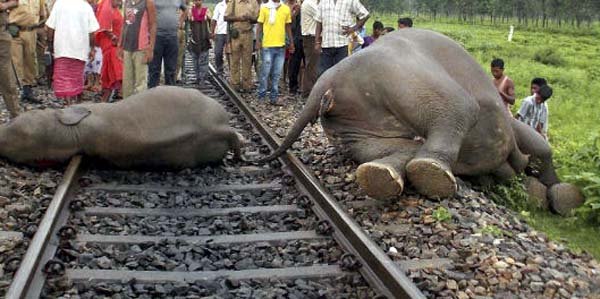
New Delhi, Mar 12: As train collisions continue to kill elephants in several parts of India, the Environment Ministry and the Wildlife Institute of India (WII) held a two-day workshop in Dehradun on March 10–11 to discuss ways to reduce the deaths and improve coordination between railway and wildlife authorities.
The meeting brought together around 40 participants, including officials from the environment ministry, the railways, forest departments of elephant-range states and conservation scientists.
India holds more than 60% of the world’s Asian elephant population, with major habitats across eastern, northeastern, southern and central regions. But railway lines running through forests and wildlife corridors have led to frequent elephant deaths in states such as Assam, West Bengal, Uttarakhand, Odisha, Tamil Nadu, Karnataka, Kerala, Chhattisgarh and Jharkhand.
Government agencies and researchers have identified 127 railway stretches covering 3,452 km across elephant landscapes for detailed review. These sections were surveyed by teams from Project Elephant, WII, forest departments and Indian Railways to understand local ecological conditions and elephant movement patterns.
Based on these surveys, 77 stretches covering about 1,965 km across 14 states have been marked as priority areas where mitigation measures are needed to reduce wildlife–train collisions.
The proposed measures include 503 ramps and level crossings, 72 bridge modifications, 39 fencing or trenching structures, four exit ramps, 65 underpasses and 22 overpasses, a total of 705 structures aimed at helping animals cross railway lines safely.
Some railway projects have already incorporated wildlife-friendly design features.
In Assam, a 3.5-km stretch of the Azara–Kamakhya railway line that passes through the Rani–Garbhanga–Deepor Beel elephant corridor will be elevated to allow elephants to move across the area more safely. Several elephant deaths have occurred along this stretch in the past.
Authorities are also testing technology-based warning systems. One of them is a Distributed Acoustic System (DAS)-based intrusion detection system, which detects movement near railway tracks and alerts railway staff.
Pilot installations have been set up in four sections of the North East Frontier Railway, covering 64 km of elephant corridors and 141 km of railway track sections in Assam. Similar systems are being introduced in parts of North Bengal and Odisha, the ministry highlighted.
Another early-warning system in Madukkarai in Tamil Nadu uses 12 tower-mounted cameras with thermal and motion sensors. The system detects elephants approaching railway tracks and sends alerts to railway and forest officials so that trains can slow down.
During the workshop, participants discussed factors that contribute to elephant–train collisions, including habitat fragmentation, land-use change, high train speeds, night-time train movement and seasonal elephant migration.
Experts also stressed the need for closer coordination between railway authorities, forest departments and researchers, along with better monitoring and early-warning systems to reduce wildlife deaths on railway tracks.