


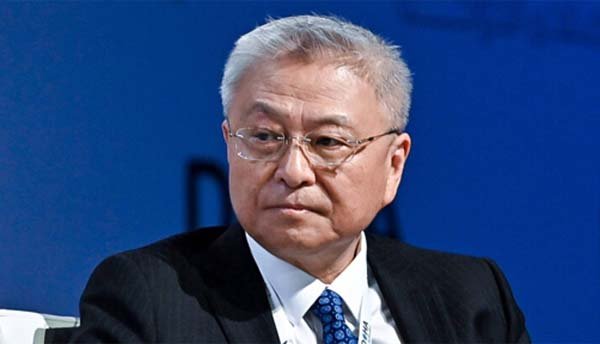
Arti Bali
New Delhi, March 7 (UNI) Against the backdrop of escalating tensions surrounding Iran with widening geopolitical strains in West Asia, former secretary-general of World Peace Forum (WPF) Yan Xuetong has warned that the possibility of further conflicts involving other countries cannot be ruled out, particularly under the policies of US President Donald Trump.
In an exclusive interview with UNI, Yan said recent developments point to a worrying pattern in global politics.
“Iran cannot rely on any external power to protect itself against a potential American attack. That’s the hard reality. The Trump administration attacked seven countries in twelve months. Now it’s Iran. After Iran, there may be another country. The pattern is not difficult to read,” he said.
Trump has also signalled Cuba as a potential next focus while the United States remains engaged in tensions with Iran, with indications that Secretary of State Marco Rubio may be tasked with handling the issue.
According to Yan, the situation raises deeper questions about the ability of the international system to protect national sovereignty. Referring to the principles of the United Nations Charter, he said enforcement mechanisms remain weak when powerful nations are involved.
“So, the real question isn’t just about Iran, it’s about whether any country’s sovereignty can be protected at all. The UN Charter says member states must respect each other’s sovereignty, but it doesn’t tell us how to enforce that when the violator is the most powerful nation on earth,” Yan said.
He argued that the international community needs new institutional mechanisms to ensure sovereignty protections are practical rather than symbolic.
“We genuinely need new international institutions and norms that make sovereignty protection practical and realistic, not merely aspirational language in documents that no one enforces,” he said, adding that regional cooperation may be the most realistic starting point.
“Realistically, the best starting point is regional cooperation, because internationally, a unified solution simply isn’t pragmatic right now,” Yan added.
He also pointed to the broader use of economic pressure and sanctions by Washington against various governments, as seen in Venezuela and Iran, as part of a wider strategy that combines economic coercion with geopolitical pressure. Such tactics, he warned, could lead to further confrontations in the international arena if diplomatic mechanisms fail to keep tensions in check.
Reflecting on the changing balance of power in global politics, the expert noted that during the Cold War era, the presence of the Soviet union acted as a counterweight capable of constraining US military actions. Today, however, he argued that no country possesses a comparable level of military capability to exert similar restraint, making it more difficult to prevent unilateral actions that may violate international norms.
On the issue of nuclear tensions surrounding Iran, Yan suggested that the debate over nuclear weapons may not be the core factor driving the confrontation.
“Any country that truly wants to build a nuclear weapon can do so within two years. It doesn’t take thirty,” he said, noting that technological barriers are not insurmountable for states with significant scientific capacity.
Tehran has consistently maintained that its nuclear programme is for peaceful purposes. Yan argued that the prolonged dispute suggests the nuclear issue might not be the primary concern.
“The sanctions and pressure, driven significantly by Israel’s strong lobbying influence in Washington, have caused immense and lasting damage to ordinary Iranian people over decades,” he said.
He warned that a military strike on Iran could have far-reaching consequences beyond its borders. “The devastation that follows a strike would be catastrophic, not just for Iran, but for regional stability across the entire Middle East,” Yan said.
Amid rising protectionism, geopolitical rivalries, and technological transformation, the expert said that the international community must urgently focus on protecting human lives and national sovereignty as the global order undergoes rapid change.