




Jayanta Roy Chowdhury
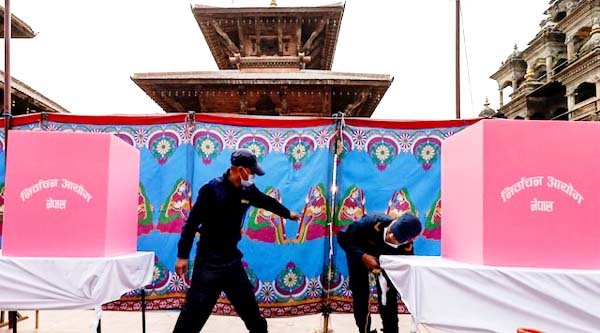
Kathmandu / New Delhi, March 5 (UNI) Voting began across Nepal on Thursday under tight security in the first national elections since last year’s youth-led uprising that unseated the government of former Prime Minister KP Sharma Oli.
Polling stations opened early across the Himalayan nation, with voters lining up in several districts amid high expectations of political change and heavy deployment of security personnel.
Authorities said Nepal Police and Armed Police Force units were stationed across sensitive constituencies to ensure peaceful voting.
The election marks a critical political moment for Nepal following the September revolt led largely by Gen Z protesters and student groups, which triggered weeks of demonstrations and eventually forced Oli’s government from power.
“At the heart of last year’s protests was widespread frustration over chronic economic stagnation and a growing army of jobless youths,” pointed out KC Sunil, President of NICCI, a chamber of commerce.
Nepal, one of the world’s poorest countries, struggles with the South Asian region’s lowest per capita income and an unemployment rate approaching 13 per cent, according to official estimates.
The economic hardship has been compounded by deep-seated corruption among political elites and a heavy reliance on remittances from a large segment of the population who have been forced to work abroad in search of opportunities.
Nepal’s youth will be looking for answers to these problems in Thursday’s elections being overseen by the interim government led by former chief justice Sushila Kharki.
“I see this as one of the best managed and free elections in Nepal,” said Kuvera Chalise, Consulting Editor of Nepalkhabar.
Voters are directly electing 165 members to the House of Representatives, the lower chamber of Parliament. The remaining 110 seats in the 275-member body will be allocated through a proportional representation system under which political parties nominate lawmakers based on their share of the vote.
The elections are widely seen as a three-way contest between the newly formed Rastriya Swatantra Party (RSP), led by former rapper Balendra Shah, and established political forces including Oli’s Communist Party of Nepal (Unified Marxist–Leninist) (CPN-UML), the Communist Party of Nepal (Maoist Centre), and the centrist Nepali Congress, led by 49-year-old Gagan Thapa.
“We see RSP doing well as also Nepal Congress with both emerging as two big pillars in the next parliament. Who will be the largest party will of course be clear by tomorrow afternoon,” said Chalise.
Analysts say the RSP could have an advantage given Nepal’s youthful demographic profile and the momentum generated by last year’s protest movement. However, many also expect the elections to produce a fractured mandate, making it likely that a coalition government will have to be formed once results are declared.
Vote counting will begin immediately after polling ends, with early trends expected later in the evening.