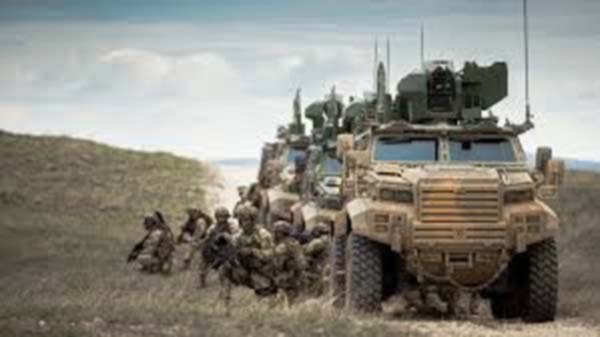






Budapest, (UNI) Hungary is set to deploy military personnel and equipment near key energy facilities, said Prime Minister Viktor Orban on Wednesday, stating that Budapest must bolster its defensive capabilities to guard against the potential hostile actions by Ukraine.
In a video posted on social media, Orban said Hungary would strengthen the protection of all its critical energy infrastructure in order to prevent any further disruption.
“Military personnel and equipment necessary to prevent attacks will be deployed near key energy facilities,” he said, adding that police forces would increase patrols around power plants, distribution stations and control centres.
The deployment of troops around energy infrastructure marks a further escalation in Budapest’s response to the latest transit dispute, as concerns grow over the resilience of critical supply networks in the region.
Budapest’s move comes amid increasingly heightened tensions with Kyiv over energy transit routes, as Hungary remains heavily reliant on the supply of Russian crude delivered via the Soviet-era Druzhba pipeline, which is considered an imperative delivery network for crude to several Central and East European countries.
Since Russia’s full-scale assault on Ukraine in 2022, the pipeline has become a highly sensitive strategic target, with attacks alleged to be carried out by Ukraine resulting in periodic disruptions and disputes over transit fees and posing strong risks to energy security.
On Monday, Hungarian Foreign Minister Peter Szijjarto announced that Budapest had blocked the European Union’s proposed 20th package of sanctions against Russia, as well as a €90 billion (around $106 billion) loan package for Ukraine, in response to Kyiv’s decision to shut down transit flows through Druzhba.
“I have ordered reinforced protection of critical infrastructure, troop deployment where necessary, increased police presence, and a drone ban in Szabolcs-Szatmar-Bereg county,” Orban wrote on X, in reference to Ukraine.
Orban’s political director, Balazs Orban, claimed that information available to the country’s authorities indicated that Kyiv has been “preparing further actions aimed at disrupting the operation of Hungary’s energy system.”
Hungary has repeatedly accused Kyiv of political blackmail by using its control over the Druzhba as leverage against Budapest, by intentionally delaying repairs following a total halt of supplies on January 27, following an attack on the pipeline, which Budapest alleges was orchestrated by Kyiv.
The disruption in the pipeline has also greatly affected Slovakia and the Czech Republic.
On February 13, Slovakia’s Economy Ministry announced that oil supplies via Druzhba had been suspended.
Although officials initially expected flows to resume within days, deliveries did not restart, eventually leading to the Slovak government to declare a crisis situation due to oil shortages, and authorised the release of up to 250,000 tonnes of crude from state reserves to the Slovnaft refinery.
Slovak Economy Minister Denisa Sakova said the Ukrainian side had postponed the restoration of supplies several times, urging Kyiv to not resort to using energy security as leverage.
Hungary has frequently clashed with Brussels over sanctions policy and military assistance to Ukraine, arguing that such measures risk undermining European energy security, economic stability, and territorial security, as any Ukrainian admission will needlessly bring the EU into direct conflict with Russia. UNI ANV SSP
Hungary set to deploy military personnel and equipment near critical energy facilities