






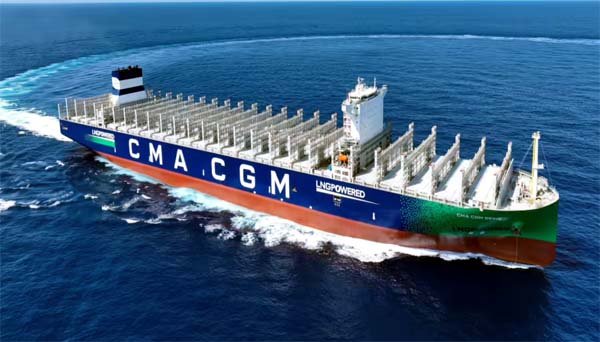
Kochi, Feb 20 (UNI) India’s Cochin Shipyard Ltd (CSL) has signed a contract with French shipping group CMA CGM for the construction of six state-of-the-art 1,700 twenty-foot equivalent unit (TEU) LNG dual-fuel feeder container vessels, significantly strengthening India’s footprint in the global green shipbuilding market.
The order entails the construction of six advanced 1,700 TEU feeder container ships powered by dual-fuel engines capable of operating on liquefied natural gas (LNG) as well as conventional marine fuels. Designed with optimised hull forms and equipped with advanced energy-efficiency technologies, the vessels are expected to deliver significantly lower emissions compared to traditional fuel-powered ships, aligning with the global shift toward cleaner and more sustainable shipping solutions.
The Shipbuilding Contract (SBC) was signed between CSL Chairman and Managing Director Jose V J and CMA CGM Chairman and CEO Rodolphe Saadé at a high-profile ceremony attended by Shantanu Thakur, Minister of State for Ports, Shipping and Waterways.
Notably, this marks the first large series of LNG dual-fuel feeder container vessels to be built by CSL for a major European container shipping operator. LNG is increasingly emerging as a transitional marine fuel of choice, with global shipping lines placing growing emphasis on dual-fuel vessels to comply with stringent environmental regulations and international decarbonisation commitments.
The prestigious contract reflects strong international confidence in CSL’s technical excellence, project execution capabilities, and sustained commitment to environmentally responsible shipbuilding. It represents a major milestone in CSL’s strategic expansion into the global container shipbuilding segment, enhancing its credibility among leading international shipping companies.
The project is also expected to significantly bolster CSL’s technological expertise in LNG dual-fuel propulsion systems, reinforce its export order book, and generate valuable foreign exchange earnings. Industry observers view the deal as a decisive step in positioning India as a competitive hub for technologically advanced and sustainable ship construction.
The agreement dovetails with the Government of India’s broader maritime development agenda, including initiatives such as Make in India, Maritime India Vision 2030, and Maritime Amrit Kaal Vision 2047, all aimed at strengthening maritime self-reliance and advancing India’s long-term vision of a robust, innovation-driven blue economy.
Financial details of the deal were not disclosed.