


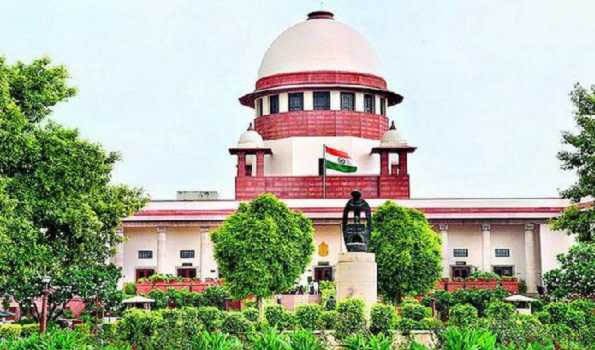
New Delhi, Feb 10 (UNI) Dhrupad vocalist Faiyaz Wasifuddin Dagar has approached the Supreme Court challenging a September 2025 judgment of the Delhi High Court that set aside an interim order granting him relief in a copyright dispute involving composer A.R. Rahman and others over the song “Veera Raja Veera” from the film ‘Ponniyin Selvan II’.
A Bench comprising Chief Justice of India (CJI) Justice Surya Kant, Justice Joymalya Bagchi and Justice N.V. Anjaria on Tuesday adjourned the matter to February 13 (Friday).
Dagar has assailed the decision of a Division Bench of the Delhi High Court, which overturned a single judge’s interim order in his suit alleging copyright infringement.
He claims that “Veera Raja Veera” is substantially copied from “Shiva Stuti”, a Dhrupad composition by his late father Nasir Faiyazuddin Dagar and uncle Zahiruddin Dagar, popularly known as the Junior Dagar Brothers
According to Dagar, while the lyrics of the film song differ, its taal, rhythm and musical structure are identical to ‘Shiva Stuti’, which was performed internationally by the Junior Dagar Brothers and released commercially by PAN Records.
Before the Delhi High Court, AR Rahman had denied the allegations, contending that Shiva Stuti is a traditional Dhrupad composition in the public domain, and that ‘Veera Raja Veera’ is an original work based on Western musical fundamentals, comprising 227 distinct layers, and far removed from conventional Hindustani classical structures.
In April 2025, a single judge of the Delhi High Court had found a prima facie case of copyright infringement and directed that the song also credit Faiyazuddin Dagar and Zahiruddin Dagar as composers.
The court had further directed Rahman and the production entities to deposit Rs 2 crore with the Registrar General of the High Court, pending disposal of the suit.
However, the Division Bench subsequently set aside the interim order, holding that Dagar had failed to establish a sufficient prima facie case of authorship or originality.
The Bench observed that the composition drew from the broader Dhrupad and Dagarvani tradition and could not, at the interim stage, be treated as an original work attributable exclusively to the Junior Dagar Brothers.
Challenging this finding before the Supreme Court, Dagar has argued that the Division Bench exceeded the permissible limits of appellate interference while overturning an interim injunction granted by the single judge.
His plea contends that the High Court erred in holding that there was insufficient proof of authorship of Shiva Stuti, asserting that Indian copyright law does not mandate written musical notation, and that fixation through sound recordings is a valid mode of establishing authorship.
He has relied on the 1978 Amsterdam performance recording and its commercial release by PAN Records, which, according to him, constituted fixation in law and had been accepted as such by the single judge.
Dagar has also questioned the Division Bench’s interpretation of Section 55(2) of the Copyright Act, which presumes authorship where an author’s name appears in association with a published work.
He has argued that the provision creates only a rebuttable presumption and that the absence of an author’s name does not defeat a claim of authorship.
Further, the plea challenges the High Court’s approach to originality, alleging that the Division Bench wrongly imported standards akin to “inventive step” from patent law into copyright jurisprudence.
It emphasises that copyright protection requires only that a work originates from the author and is not copied, not that it be novel or innovative.
The plea also alleges that the Division Bench failed to adequately consider moral rights under Section 57 of the Copyright Act.
The matter is now listed before the Supreme Court for further hearing on February 13.