





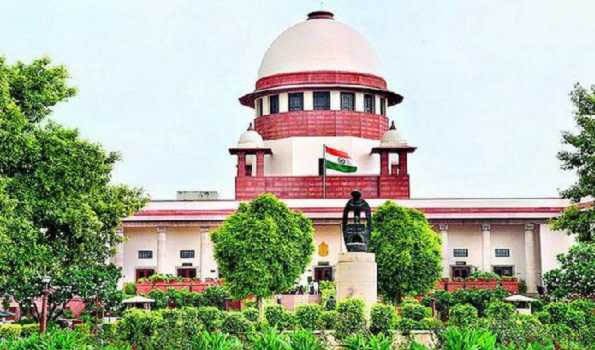
New Delhi, Feb 9 (UNI) The Supreme Court on Monday extended by one week the deadline for completion of the Special Intensive Revision (SIR) of electoral rolls in West Bengal, while issuing stern warnings against any obstruction to the exercise and directing the State to ensure full cooperation with the Election Commission of India (ECI).
A Bench comprising Chief Justice of India (CJI) Justice Surya Kant, Justice Joymalya Bagchi and Justice NV Anjaria directed that more than 8,000 State government officers earmarked for SIR-related duties must report to their respective District Electoral Officers by Tuesday evening.
The Court made it clear that it would not tolerate any impediment to the revision process. “We will not allow any impediment in the conduct of SIR. This must be clear to all States,” the CJI observed.
The directions came after the ECI submitted that it was not receiving adequate assistance from the West Bengal government and alleged that the SIR exercise in the State was being affected by violence, intimidation and sustained political interference.
Taking serious note of these allegations, the Court reiterated its earlier direction to the police to ensure maintenance of law and order and asked the Director General of Police of West Bengal to file a personal affidavit addressing the concerns raised.
Appearing for the union government, Solicitor General Tushar Mehta submitted that a clear constitutional message must go out that the rule of law applies uniformly across all States.
The ECI also informed the Court that it had recommended suspension of certain officers for non-cooperation, but no action had been taken by the State so far.
The Bench directed the State government to act on such recommendations and held that the ECI would be at liberty to replace officers who were not performing their duties satisfactorily.
The Court further clarified that while the ECI may scrutinise the bio-data of State officers being deputed, it could utilise those found suitable after imparting a brief training of one or two days, particularly as micro observers.
However, the Bench emphasised that micro observers would not have any decision-making role and would only assist the Electoral Registration Officers (EROs), a clarification recorded on the basis of ECI’s submission.
Considering that a new set of officials had been inducted and that scrutiny of documents submitted by affected voters would take additional time, the Court extended the deadline for completion of the SIR in West Bengal by one week beyond February 14.
During the hearing, Justice Joymalya Bagchi expressed concern over what he described as the widespread and mechanical issuance of notices to voters in the State.
He flagged instances where notices were reportedly issued over minor discrepancies such as middle names, observing that such an approach did not reflect social realities in Bengal.
“The tools applied to the software are very restrictive. ‘Kumar’ is a common middle name in Bengali households. Sending notices for such minor variations is problematic,” Justice Bagchi remarked.
The Court asked the ECI to exercise caution while issuing notices on the basis of name mismatches and other so-called “logical discrepancies,” even as the Commission defended notices in cases involving serious anomalies, such as multiple voters tracing parentage to a single individual.
The Bench also heard extensive submissions from counsel appearing for various petitioners challenging the SIR.
Senior Advocate Shyam Divan submitted that out of over seven crore electors on the draft list, a significant number had been flagged for logical discrepancies, many of them due to minor name variations, and warned against the risk of mass disenfranchisement if the final list was published in haste.
Senior Advocate Abhishek Manu Singhvi, appearing for the State of West Bengal, informed the Court that thousands of Block Level Officers, Assistant Electoral Registration Officers and Electoral Registration Officers had been made available to the ECI, though the Commission contended that complete details and appropriate categories of officers had not been provided.
Senior Advocate DS Naidu, for the ECI, reiterated that officers involved in the SIR were required to have experience in quasi-judicial decision-making, given that their decisions could be subject to appellate scrutiny.
The Court permitted the ECI to assess the suitability and usefulness of the officers being deputed and to provide necessary training.
The Bench also took note of submissions regarding alleged violence and destruction of objection forms in certain areas and underscored the need for a fair, orderly and lawful completion of the SIR exercise.
The Court has reserved judgment on the batch of petitions challenging the legality and manner of conduct of the SIR, while making it clear that the electoral revision process must proceed without fear, favour or obstruction, in accordance with constitutional principles.