


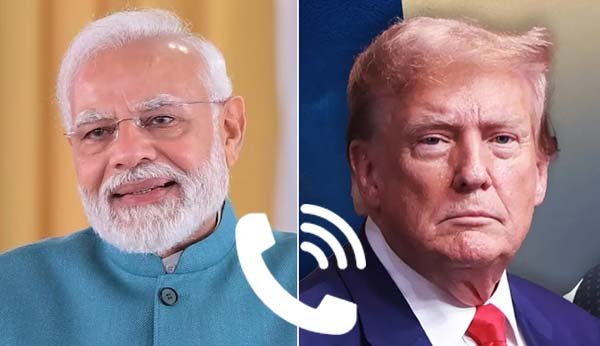
New Delhi, (UNI) In a major development, the US on Monday slashed tariffs on India to 18 per cent, from the high of 50 per cent, following telephone talks between Prime Minister Narendra Modi and US President Donald Trump.
The Trump administration had slapped 50 per cent punitive tariffs on India, including 25 per cent for its purchase of Russian oil.
The US Embassy spokesperson Christopher Elms said “the final tariff on Indian goods is now 18 percent”.
The US Ambassador Sergio Gor also confirmed to a news channel that the US administration is cutting down tariffs on Indian imports from 50% to 18%.
“All the credit goes to President Trump and PM Modi. The two leaders have a great personal relationship, which has carried the deal forward. The number that will be finalised will be 18%,” Gor told CNN-NEWS18.
“As you saw the President’s Truth Social post, part of agreement is all nations around the world stop buying oil from Russia in order to bring peace to the situation. I know that the Prime Minister deeply cares about bringing peace in the conflict as does President Trump, so the number that will be finalised is 18%,” Gor said.
Earlier, US President Donald Trump announced a new trade understanding with India following a phone call with Prime Minister Narendra Modi, saying the United States will cut its tariff on Indian goods from 25 percent to 18 percent and that India has agreed to significant purchases of US products and to alter its energy sourcing strategy.
In a post on his Truth Social platform, Trump described the conversation with Modi as “an honor” and portrayed the development as a breakthrough in bilateral economic and strategic cooperation.
“It was an Honor to speak with Prime Minister Modi… He is one of my greatest friends and a Powerful and Respected Leader of his Country,” Trump wrote, while detailing agreed changes on trade and energy.
Trump said that, effective immediately, the United States had agreed to a reciprocal tariff deal with India, reducing the rate it charges on imports from India from 25 percent to 18 percent. He also claimed that India would move to lower its own tariffs and non-tariff barriers on US goods to zero.
“Out of friendship and respect for Prime Minister Modi, and as per his request, effective immediately, we agreed to a Trade Deal… whereby the United States will charge a reduced Reciprocal Tariff, lowering it from 25% to 18%.”
Trump framed the tariff shift as part of an effort to rebalance longstanding trade frictions between the two countries, after months of strained negotiations that had earlier led Washington to impose high duties on Indian exports.
In the same post, Trump said the leaders also discussed broader strategic issues, including the war between Russia and Ukraine.
“He agreed to stop buying Russian Oil, and to buy much more from the United States and, potentially, Venezuela. This will help END THE WAR in Ukraine…” Trump wrote, connecting India’s energy sourcing choices with global security outcomes.
Prime Minister Modi in a post on X announced that the United States will reduce tariffs on Made-in-India products to 18 per cent, calling it a major boost for bilateral trade, following a conversation with US President Donald Trump.
The Prime Minister said he had a “wonderful” conversation with President Trump and thanked him for what he described as a significant step benefiting Indian exporters and consumers.
“Delighted that Made in India products will now have a reduced tariff of 18%. Big thanks to President Trump on behalf of the 1.4 billion people of India for this wonderful announcement,” PM Modi said.
PM Modi said closer cooperation between India and the United States — the world’s two largest democracies and major global economies — would unlock new opportunities for trade, investment and innovation.
“When two large economies and the world’s largest democracies work together, it benefits our people and unlocks immense opportunities for mutually beneficial cooperation,” he said.
While detailed sector-wise implications of the tariff reduction were not immediately available, the announcement is expected to provide relief to Indian manufacturers and exporters, particularly in sectors that have faced higher duties in the US market in recent years.
The Prime Minister also praised President Trump’s leadership on global issues, underscoring India’s support for US-led peace efforts.
“President Trump’s leadership is vital for global peace, stability, and prosperity. India fully supports his efforts for peace,” PM Modi said.
He added that he looked forward to deepening strategic cooperation with Washington.
“I look forward to working closely with him to take our partnership to unprecedented heights,” the Prime Minister said, tagging the US President in his post.
The latest announcement comes amid efforts by both sides to strengthen economic engagement and re-energise the strategic partnership, as global supply chains realign and geopolitical uncertainties persist.
Trump also praised the personal rapport between the two leaders, asserting: “Our amazing relationship with India will be even stronger going forward… Prime Minister Modi and I are two people that GET THINGS DONE.”
US Ambassador Gor, in a post on X, said: “As I have said many times, President Trump genuinely considers Prime Minister Modi a great friend! Thrilled by the news of the trade deal this evening. The relationship between the United States and India has LIMITLESS POTENTIAL”
Indian Ambassador to the US, Vinay Mohan Kwatra, in a post on X, lauded the new development.
“A big WIN for a consequential partnership under the leadership of Prime Minister Narendra Modi @narendramodi and President Donald Trump @POTUS
“India and USA announce trade deal creating vast new opportunities for the two economies and the people of our two great nations. Today’s announcements herald an exciting new phase in our partnership.”
The positive development comes amid a period of difficult trade relations between India and the United States.
In 2025, Washington imposed steep tariffs on Indian imports, in part in response to New Delhi’s purchase of discounted Russian crude, triggering market concerns and political debate in both countries.