



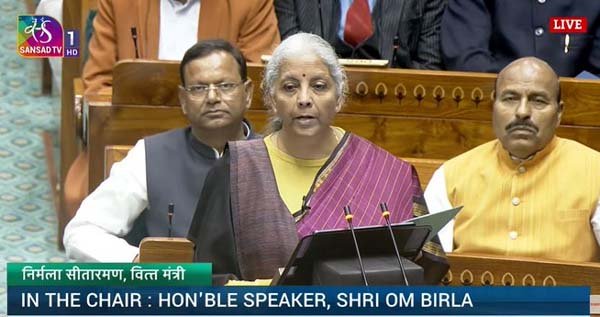
New Delhi, Feb 1 (UNI) With the Cabinet approving the Budget, union Finance Minister Nirmala Sitharaman on Sunday began presenting the union Budget for the financial year 2026–27 in the Lok Sabha during the Budget Session of Parliament.
Sitharaman is presenting her record ninth consecutive union Budget today at 11 am. She will outline a statement of the estimated receipts and expenditures of the government for the year 2026–27.
The Finance Minister will also table two statements under Section 3(1) of the Fiscal Responsibility and Budget Management (FRBM) Act, 2003. These include the Medium-Term Fiscal Policy-cum-Fiscal Policy Strategy Statement and the Macro-Economic Framework Statement.
Ahead of the union Budget 2026 presentation in Parliament, President Droupadi Murmu on Sunday offered ‘dahi-cheeni’ (curd and sugar) to Finance Minister Nirmala Sitharaman upon her arrival at Rashtrapati Bhavan.
The ‘dahi-cheeni’ ritual is performed by the President as it is considered an auspicious way to commence the day. This customary good-luck gesture took place during the Finance Minister’s meeting with President Murmu. Minister of State for Finance Pankaj Chaudhary was also present. During the meeting, the Finance Minister discussed the contours of the Budget proposals with the President.
Sitharaman is likely to use Part B of her Budget speech to present a detailed economic vision for India’s future growth, breaking a 75-year-old tradition.
Traditionally, key announcements and the broader economic narrative have been presented in Part A, while Part B has primarily focused on tax proposals and policy changes. This time, however, Part B is expected to take center stage, according to sources.
Sources indicate that the Finance Minister will outline both short-term priorities and long-term goals as India moves further into the second quarter of the 21st century. The emphasis will be on leveraging India’s domestic strengths while positioning the country to meet its global ambitions.
Expectations are high that the government will strike a careful balance between sustaining economic growth, generating employment, and maintaining fiscal discipline amid a challenging global environment. Economists believe that the Finance Minister is expected to build on recent reforms while addressing domestic priorities such as boosting consumption, supporting capital expenditure, and strengthening the manufacturing and services sectors.
The Budget is being presented in a paperless format. Sitharaman had earlier, in 2019, broken tradition by replacing the leather briefcase with a red cloth-wrapped bahi-khata.
The Budget comes at a time when India remains one of the fastest-growing major economies, even as global growth moderates due to geopolitical uncertainties, tight financial conditions, and slowing demand in key markets.
Ahead of the Budget, the ‘halwa ceremony’, marking the final stage of the preparation process for the union Budget 2026–27, was held on January 27 at the Budget Press in North Block. The Economic Survey 2026 was also tabled in Parliament on January 29. According to the Survey, the Indian economy is expected to expand by 6.8–7.2 per cent in FY27, supported by strong macroeconomic fundamentals and a series of regulatory reforms.