

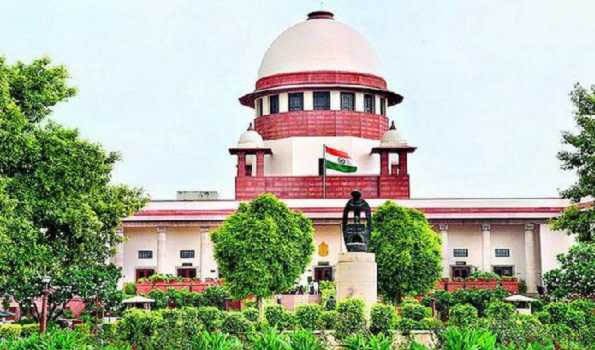
New Delhi, Jan 27 (UNI) The Supreme Court on Tuesday resumed hearing a batch of petitions challenging the Election Commission of India’s (ECI) decision to undertake a Special Intensive Revision (SIR) of electoral rolls across various States, even as the poll panel informed the Court about alleged large-scale violence, intimidation and threats faced by election officials during the SIR process in West Bengal.
Appearing for the Election Commission, senior advocate Maninder Singh submitted that the Special Intensive Revision is a statutory exercise recognised under the Representation of the Peoples Act, 1950, particularly under Section 21(3), and is essential to ensure the integrity of electoral rolls.
He argued that Articles 325 and 326 of the Constitution make it clear that citizenship and other eligibility conditions are continuous requirements for inclusion in the electoral roll. Singh contended that the distinction between citizens and non-citizens is constitutionally significant and that apprehensions raised against the SIR were unfounded.
Referring to an earlier decision of a Bench comprising Justices Sanjiv Khanna and Dipankar Datta on issues relating to EVMs, he urged the Court to apply the same test of bona fides, asserting that the present petitions were intended to discredit a constitutional authority.
He also submitted that while the Supreme Court has exercised jurisdiction under Article 32 in election-related matters in the past, such intervention is unwarranted when the challenge lacks bona fides.
Senior advocate D.S. Naidu, also appearing for the Election Commission, argued that access to constitutional courts remains open so long as a genuine grievance exists. He submitted that the prayers in the present case were camouflaged as a writ of certiorari or prohibition, despite the ECI merely exercising its statutory powers to conduct SIR.
He pointed out that the Court itself has been monitoring the process and that, to date, no individual voter had approached the Court with a concrete grievance. Naidu emphasised the distinction between “verification” and “determination”, submitting that the ECI was only verifying electoral rolls and not determining citizenship.
He said the SIR serves collateral purposes such as weeding out absentee voters and accounting for deaths or migration. Referring to Section 16 of the Representation of the Peoples Act, 1950, Naidu added that eligibility criteria such as citizenship and age have long been part of India’s electoral framework, and stressed that in 75 years of constitutional democracy, there has been no allegation that elections have been “stolen”.
In a parallel development, the Election Commission, in an affidavit filed before the Supreme Court in response to a petition, alleged a “systematic pattern of violence and threats” against election officials engaged in the SIR process in West Bengal.
The Commission claimed that unlike other States, where the exercise has been largely incident-free, West Bengal has witnessed numerous instances of intimidation, obstruction and physical attacks on Booth Level Officers (BLOs) and other officials.
The affidavit alleged that Chief Minister Mamata Banerjee had made provocative public statements that created an atmosphere of intimidation among election officials.
The EC cited a press conference held by the Chief Minister on January 14, alleging fear-mongering and the dissemination of misleading information about the SIR process, as well as the public targeting of a micro-observer performing statutory duties.
According to the Commission, the impact of such statements was felt on the ground, with nine micro-observers in the Farakka Assembly constituency of Murshidabad withdrawing from SIR duties on January 14 due to violent assaults and inadequate security.
It also cited an incident on January 15 in Uttar Dinajpur district where a mob of around 700 people allegedly attacked and ransacked a government office where SIR work was underway, destroying computer infrastructure and documents.
The EC further alleged reluctance on the part of local police authorities in West Bengal to register FIRs based on complaints by BLOs, stating that in several cases, action was taken only after intervention by senior district officials.
It claimed that despite formal acknowledgments of dereliction of duty, the State had failed to take disciplinary or penal action against erring officials.
The affidavit also referred to earlier incidents, including a protest on November 24 in which demonstrators claiming to be BLOs allegedly attempted to forcibly enter the office of the Chief Electoral Officer, Kolkata, remaining on the premises for nearly 28 hours without any FIR being registered or arrests being made.
With draft electoral rolls already published, the Election Commission stressed that completion of the SIR process “without fear or intimidation” is imperative for the preparation of accurate electoral rolls.
It cited statements attributed to a sitting Minister and an MLA of West Bengal, as well as appeals allegedly made by the Chief Minister, urging people to take the law into their own hands, as contributing to the hostile environment faced by poll officials.
The Supreme Court had issued notice in the matter on December 9 after senior advocate V. Giri, appearing for the petitioner organisation Sanatani Sangsad, raised concerns over alleged violence against BLOs and sought protection for election officials engaged in the SIR exercise.