



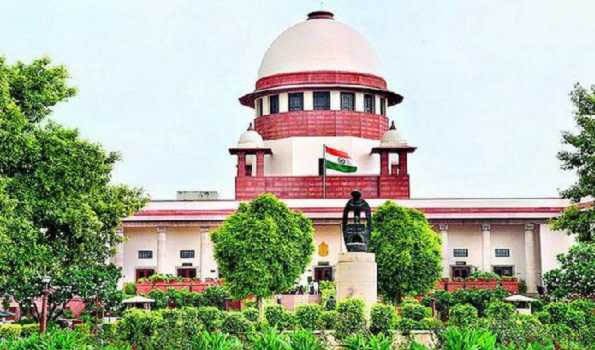
New Delhi, Jan 27 (UNI) The Supreme Court on Tuesday refused to entertain a petition challenging the practice of “VIP darshan” at the Shri Mahakaleshwar Temple in Ujjain, observing that the issue does not fall within the realm of judicial determination.
After the Court expressed its disinclination to interfere, the petitioner sought to withdraw the petition with liberty to make a representation before the appropriate authorities. The Bench allowed the request.
A Bench comprising Chief Justice of India Surya Kant, Justice R. Mahadevan and Justice Joymalya Bagchi was hearing a petition filed by Darpan Awasthi, assailing a Madhya Pradesh High Court order which had dismissed his challenge to the alleged preferential treatment extended to “VIPs” for entry into the Garbhagriha (innermost sanctum) of the temple to offer water to the deity, while restricting access to the general public.
Appearing for the petitioner, advocate Vishnu Shankar Jain contended that the practice violated Article 14 of the Constitution and that there must be a uniform policy governing entry into the Garbhagriha.
He submitted that citizens could not be discriminated against on the basis of VIP status and argued that, if entry is permitted to certain persons on the recommendation of authorities such as the Collector, similarly placed devotees should also have the right to enter and offer water to the deity.
The Bench, however, was not persuaded. Observing on the issue of justiciability, the Chief Justice stated that whether entry into the Garbhagriha should be permitted or restricted is not a matter for courts to decide and ought to be left to those entrusted with temple administration.
“If courts start regulating who should be allowed to enter and who should not, it would be too much for the courts,” the Chief Justice remarked.
The CJI further observed that if Article 14 were to be held applicable within the sanctum sanctorum, it could open the door to claims under other fundamental rights as well.
He cautioned that such an approach may lead to assertions of rights such as freedom of speech under Article 19 inside the sanctum, thereby complicating religious and administrative arrangements.
While Jain reiterated that his challenge was limited to discrimination and that there should either be complete prohibition or complete access without selective permissions, the Bench remained unconvinced.
In view of the Court’s unwillingness to interfere, the petitioner withdrew the petition.
“The petitioner seeks and is permitted to withdraw the petition and is at liberty to give his suggestions/recommendations to the competent authority,” the Court recorded in its order.
The Supreme Court also took note of the findings of the Madhya Pradesh High Court, which had observed that the minutes of the Mahakaleshwar Temple Managing Committee did not disclose any specific prohibition on entry into the Garbhagriha.
The High Court had noted that, as per the minutes, VIPs are permitted entry with the approval of the Collector and the Administrator of the Managing Committee.
The High Court had further held that the determination of who qualifies as a “VIP” is a matter of discretion vested in the competent authority and cannot be adjudicated in writ jurisdiction.
It observed that there is no permanent list or protocol defining VIPs and that permissions are granted on a case-to-case basis depending on the status of the individual on a given day.
Noting that the term “VIP” is not defined under any statute or rules, the High Court had held that any person permitted by the competent authority to enter the Garbhagriha may be treated as a VIP for that particular time and occasion.
Terming the petitioner as personally aggrieved, the writ petition was dismissed as not maintainable, the court said.