



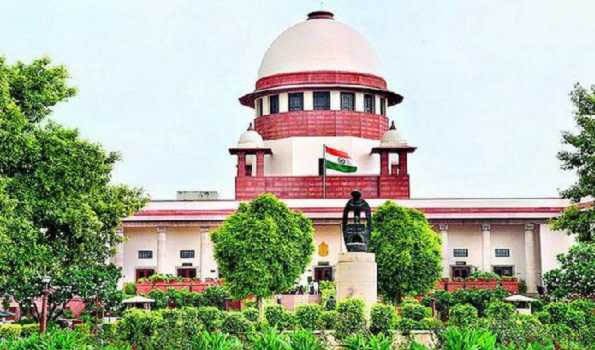
New Delhi, Jan 20 (UNI) The Supreme Court on Tuesday reserved its order on a batch of petitions seeking directions for effective action against incidents of hate speech nationwide. A Bench comprising Justice Vikram Nath and Justice Sandeep Mehta, reserving the order, directed the parties to file brief written submissions within two weeks.
The petitions are being heard in the backdrop of the Court’s earlier directions mandating that whenever speech or conduct attracts offences under provisions such as Sections 153A, 153B, 295A and 505 of the Indian Penal Code, authorities must take suo motu action to register cases and proceed against offenders, even in the absence of a formal complaint.
Senior Advocates Siddharth Aggarwal, M.R. Shamshad, Sanjay Parekh and Sanjay Hegde, along with Advocate Nizam Pasha, appeared for the petitioners. Additional Solicitor General S.V. Raju and Senior Advocate D.S. Naidu represented the respondents. Advocate Nizam Pasha, appearing for several petitioners, pointed to a persistent reluctance on the part of law enforcement agencies to act against hate speech, particularly when the accused are linked to ruling establishments.
He submitted that the problem lies not in the absence of legal provisions but in their poor implementation. Despite repeated directions of the Court, he argued, “usual suspects” continue to deliver inflammatory speeches with impunity, FIRs are often not followed by arrests, and authorities fail to act even when events are advertised in advance with a clear indication of impending hate speech.
The petitioners also flagged the evolving nature of hate speech in the digital age. Senior Advocate Siddharth Aggarwal referred to an application concerning an AI-generated video allegedly using communal narratives for political purposes. He also raised concerns over the refusal to register an FIR in a hate speech matter on the grounds of lack of sanction, contending that a sanction is required only at the stage of cognisance and not for registration of an FIR or investigation.
Senior Advocate Sanjay Hegde highlighted how hate speech now follows a lifecycle originating as a slogan or phrase, spreading through social media, and eventually being amplified by mass media. Citing instances such as the “UPSC Jihad” broadcast, he urged the Court to explore ways to make hate speech unprofitable for large corporations and digital platforms.
Senior Advocate M.R. Shamshad and Advocate Amit Pai also submitted that police authorities frequently decline to register FIRs by wrongly insisting on prior government sanction. It was pointed out that while sanction may be required at the stage of cognizance, it is not a precondition for the registration of an FIR.
Senior Advocate Sanjay Parekh, appearing for the People’s union for Civil Liberties (PUCL), argued that the focus should be on strengthening and modifying the guidelines issued in Tehseen S. Poonawalla v. union of India to more effectively address hate speech. A submission was also made that hate speech should be treated as a “constitutional tort,” recognising it as a violation of constitutional rights with discriminatory impact on marginalised communities, warranting remedies beyond criminal prosecution.
Responding on behalf of the Union, ASG S.V. Raju submitted that there had been substantial compliance with the Court’s directions. He stated that FIRs had been registered in most of the reported incidents, while in others, inquiries revealed no criminal offence. While reserving orders on the main batch of petitions, the Court clarified that one matter Kazeem Ahmad Sherwani v. State of Uttar Pradesh & Ors., relating to an alleged 2021 hate crime against a Muslim cleric in Noida would be heard separately at a later stage.
All parties were directed to file brief notes within two weeks. In November 2023, the union of India filed a status report indicating that 28 States and union Territories had appointed nodal officers in compliance with the directions issued in Tehseen S. Poonawalla.
The Supreme Court has previously clarified that it does not intend to legislate or monitor every individual incident of hate speech, noting that existing legislative mechanisms, police authorities and High Courts are in place. The Court has emphasised that its role is confined to ensuring an effective implementation framework, leaving individual grievances to be addressed before the appropriate High Courts.