



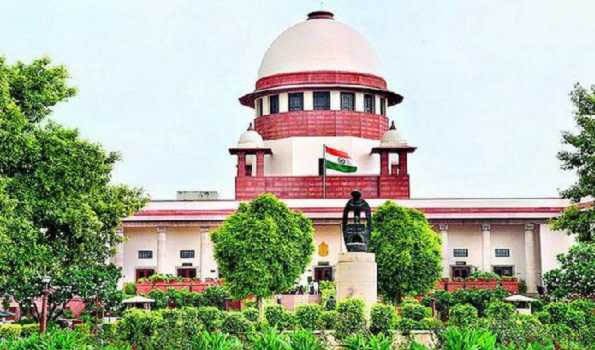
New Delhi, Jan 19 (UNI) The Supreme Court on Monday stayed a Rajasthan High Court order directing the removal or relocation of all liquor shops situated within 500 metres of National or State Highways across the State. The Bench comprising Justice Vikram Nath and Justice Sandeep Mehta passed the interim order after hearing Senior Advocate Mukul Rohatgi, appearing for the petitioner, and Solicitor General Tushar Mehta for the State of Rajasthan.
Notably, the Solicitor General supported the petitioner’s challenge to the High Court order. During the hearing, Rohatgi submitted that the matter before the High Court arose out of a grievance relating to village Sujangarh, but the High Court issued directions applicable to the entire State without hearing affected parties.
In response, Justice Mehta observed that the High Court exercises jurisdiction throughout the State. Rohatgi, however, contended that the impugned order was contrary to binding Supreme Court precedent, which did not impose a blanket prohibition on licensed liquor establishments located within municipal areas.
“The judge still says there will be a ban that cannot be,” Rohatgi submitted. At this point, Justice Nath remarked, “Judges can do everything,” to which Rohatgi responded that the judge being the senior-most at Jodhpur may have proceeded on that basis. Intervening, the Solicitor General urged restraint in such remarks.
Justice Mehta also noted that the issue was sensitive, given the number of deaths attributed to drunk driving, and observed that the concern underlying the High Court’s order was “absolutely genuine.” He added that the State could, in future, take appropriate steps to ensure that liquor vends are not located along highways.
In an exchange during the hearing, the Solicitor General referred to what he described as “Indian ingenuity,” pointing out that in some States, where hoardings advertising liquor are prohibited, only directional arrows are displayed.
“Those who know, know what it means,” he said. Rohatgi added that there are also “shadow advertisements” relating to soda and water. Justice Mehta, smiling, remarked that he was unaware of such practices. The High Court order under challenge was passed in December on a petition highlighting a steep rise in drunk driving cases in Rajasthan during 2025.
Taking note of the increasing number of highway accidents attributed to alcohol misuse, the High Court had directed the State to remove or relocate all liquor shops within 500 metres of National or State Highways within two months, irrespective of whether such shops were located in municipal areas, local self-governing bodies or statutory development authorities.
The High Court, in its order, referred to the Supreme Court’s decision in State of Tamil Nadu v. K. Balu, which recorded the alarming scale of road accidents caused by speeding and alcohol consumption and directed that no liquor shops be situated within 500 metres of the outer edge of National or State Highways.
The Supreme Court had subsequently clarified that the prohibition did not extend to licensed establishments located within municipal areas, leaving it to the discretion of State Governments to decide whether to extend the restriction to areas under local bodies and development authorities.
Against this backdrop, the High Court held that Rajasthan had misused the limited discretion granted under the Supreme Court’s ruling. It relied on an affidavit filed by the Excise Department stating that the State had permitted 1,102 liquor shops to operate along National and State Highways by treating them as falling within municipal or local body limits, generating revenue of Rs. 2,221.78 crore.
Expressing serious concern, the High Court observed that revenue considerations could not override the constitutional obligation to protect public life and road safety. It held that alcohol misuse and reckless driving had reached dangerous proportions, infringing the right to life under Article 21, and directed the removal or relocation of all liquor shops within the restricted zone, along with a prohibition on hoardings or advertisements relating to liquor being visible from highways.
Challenging these directions, the petitioner approached the Supreme Court, which has now stayed the High Court order and will hear the matter further.