



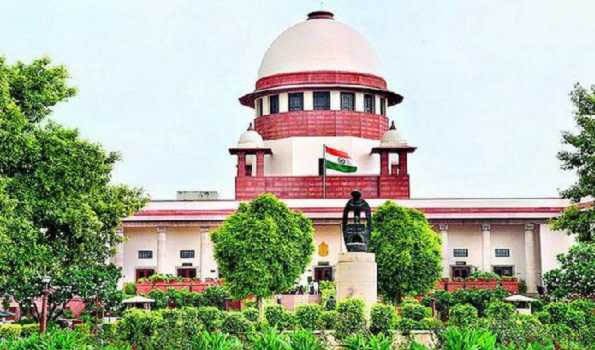
New Delhi, Jan 12 (UNI) The Supreme Court on Monday agreed to examine the issue of implementing the ‘creamy layer’ principle in reservations granted to Scheduled Castes (SCs) and Scheduled Tribes (STs).
A Bench comprising Chief Justice of India Surya Kant and Justice Joymalya Bagchi issued notice in a public interest litigation filed under Article 32 of the Constitution seeking exclusion of the creamy layer from SC/ST reservations.
The petitioner, Ashwini Kumar Upadhyay, appeared in person before the Court. The plea contends that the non-exclusion of the creamy layer from SC/ST reservations violates multiple constitutional provisions, including Articles 14, 15, 16, 17, 38, 41, 46, 51A(j) and 335.
It asserts that affluent and socially advanced families within SC/ST communities are cornering a substantial portion of reserved seats in competitive examinations and public employment, thereby depriving the most disadvantaged sections of the intended benefits.
According to the petitioner, the cause of action arose on December 1, 2025, when it came to light that members of the creamy layer within SC/ST categories were availing reservation benefits across union and State civil services examinations, as well as in entrance tests such as JEE, NEET, CLAT, CAT and recruitment processes in banks, railways and other government services.
The petition argues that reservations were envisaged by the Constitution’s framers as a tool for socio-economic justice and not as a permanent or blanket entitlement. It submits that excessive reservation without periodic assessment and without exclusion of the creamy layer is contrary to the constitutional ethos of justice, equity and equal opportunity.
Relying on Constituent Assembly debates and speeches of Dr B.R. Ambedkar, V.I. Muniswamy Pillai and Jaipal Singh, the plea urges a purposive interpretation of the Constitution.
It maintains that while reservation may be a means to achieve development and equality, it cannot become an end in itself, as economic efficiency, national unity and social harmony are integral to constitutional governance.
The petition categorises the impact of the existing reservation framework into national, social, economic and cultural dimensions.
It alleges that the absence of a creamy layer filter has resulted in “elite capture” within SC/ST communities, leading to the creation of a “class within a caste” where benefits circulate within a limited group of families. This, it claims, undermines genuine empowerment and fosters identity-based politics rather than inclusive development.
On the cultural front, the plea contends that continued inclusion of the creamy layer dilutes the cultural identity and unity of SC/ST communities, marginalising the most disadvantaged sections and rendering their lived realities invisible.
The petition raises several questions of law for the Court’s consideration, including whether reservation without exclusion of the creamy layer in SC/ST categories is consistent with the Preamble, Articles 14, 15, 16, 19(1)(g) and 21, and whether the State is constitutionally obligated to identify and exclude the creamy layer to ensure substantive equality and temporal reasonableness in affirmative action policies.
The petitioner has sought directions to the Centre and States to take appropriate steps to implement the creamy layer system in SC/ST reservations.
The plea also places reliance on the Supreme Court’s August 2024 judgment, which held that sub-categorisation and sub-division within SC/ST categories is permissible and observed that, for the effective operation of affirmative action, the creamy layer should be excluded from reservations extended to SCs and STs.