


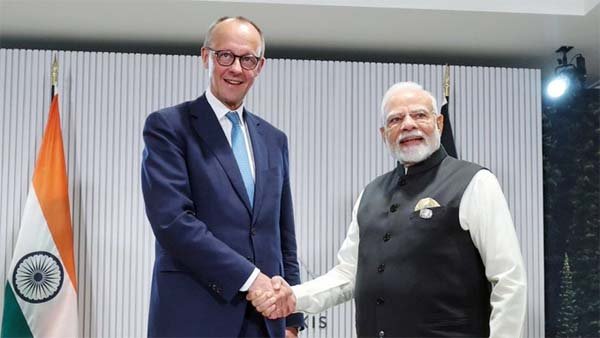
New Delhi/Ahmedabad, Jan 12 (UNI): German Federal Chancellor Friedrich Merz arrived in Ahmedabad on Monday on a two-day official visit to India.
Though the Chancellor has attended several multilateral meetings in the Global South, officials said this is his first bilateral trip outside NATO and European union countries since assuming office.
He was received at the airport by Gujarat Governor Acharya Devvrat, officials said.
The January 12–13 visit coincides with the 25th anniversary of the India–Germany Strategic Partnership and the 75th year of diplomatic relations between the two countries.
Officials said the visit underscores Berlin’s growing emphasis on India as a key strategic and economic partner amid shifting global geopolitical and trade dynamics.
Chancellor Merz is scheduled to hold talks with Prime Minister Narendra Modi later in the day at Mahatma Mandir in Gandhinagar.
The two leaders are expected to explore cooperation across a wide range of areas, including trade and investment, technology, defence and security, education and skilling, mobility, science and innovation, green development, and people-to-people exchanges.
The discussions are also expected to touch upon the proposed India–European union Free Trade Agreement, as well as broader Indo-Pacific developments.
Officials familiar with the agenda said Germany views India as a stabilising partner in the region at a time of global economic uncertainty, trade disruptions, and security challenges.
As part of his Ahmedabad itinerary, Chancellor Merz will pay homage at Sabarmati Ashram, attend the International Kite Festival, and visit Dandi Kutir, officials said.
On January 13, the German Chancellor will travel to Bengaluru, where he is scheduled to visit Bosch’s Adugodi campus to review cooperation in advanced manufacturing and innovation, and the Centre for Nano Science and Engineering to engage with India’s research and technology ecosystem.
Officials described the visit as strategically significant, noting that it reflects Germany’s intent to deepen economic resilience, strengthen defence and technology collaboration, and diversify supply chains through closer engagement with India.