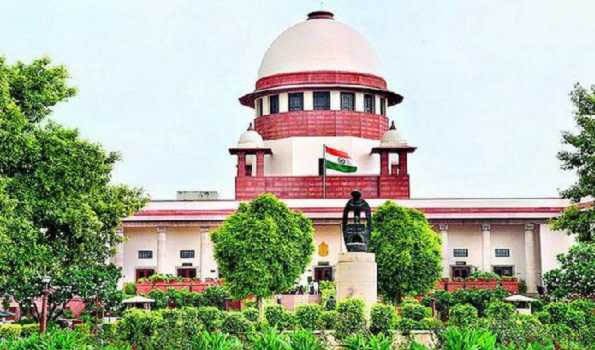





New Delhi, Jan 8 (UNI) The Supreme Court on Thursday reserved judgment on a writ petition filed by Justice Yashwant Varma of the Allahabad High Court, challenging the decision of the Lok Sabha Speaker to constitute an inquiry committee under the Judges (Inquiry) Act, 1968, in connection with impeachment proceedings initiated against him following the recovery of unaccounted cash from his official residence.
A Bench comprising Justice Dipankar Datta and Justice Satish Chandra Sharma heard the matter.
On the previous day of the hearing, the Court had orally observed that there appeared to be “some infirmity” in the manner in which the inquiry committee was constituted and indicated that it would examine whether the defect was grave enough to warrant termination of the proceedings.
The Court had issued notice in the matter on December 16, 2025, to the office of the Lok Sabha Speaker.
Justice Varma’s primary contention is that impeachment motions were moved in both the Lok Sabha and the Rajya Sabha on the same day, July 21 but Lok Sabha Speaker Om Birla proceeded to constitute the inquiry committee unilaterally, without awaiting a decision by the Rajya Sabha Chairman on admission of the motion or holding the mandatory joint consultation.
The petition argues that this course of action violates Section 3(2) of the Judges (Inquiry) Act, 1968. Reliance has been placed on the proviso to Section 3(2), which stipulates that where impeachment notices are given on the same day in both Houses, no committee shall be constituted unless the motion is admitted in both Houses, and if admitted, the committee must be constituted jointly by the Speaker of the Lok Sabha and the Chairman of the Rajya Sabha.
During the hearing, the Court was informed that the Deputy Chairman of the Rajya Sabha had rejected the impeachment motion on August 11, following which the Lok Sabha Speaker constituted the inquiry committee on August 12.
The petitioner contends that the Deputy Chairman lacked the authority to reject the motion, and therefore, the Lok Sabha Speaker could not have proceeded on the premise that the Rajya Sabha motion stood rejected.
Another issue raised was whether the then Chairman of the Rajya Sabha, Jagdeep Dhankhar, had admitted the motion on the very first day. If so, it was argued, the Deputy Chairman who assumed office after Dhankhar’s resignation could not have subsequently rejected the motion. In such a scenario, the inquiry committee, if any, ought to have been constituted jointly by the Lok Sabha Speaker and the Rajya Sabha Chairman.
Senior Advocate Siddharth Luthra, appearing for Justice Varma, argued that Article 124 of the Constitution constitutes a complete code for impeachment proceedings of judges. He submitted that Article 91 of the Constitution, which permits the Deputy Chairman of the Rajya Sabha to perform the duties of the Chairman in the latter’s absence, cannot be invoked to confer discretionary powers under the Judges (Inquiry) Act enacted under Article 124(5)—which specifically vests such powers only in the Chairman.
Senior Advocate Mukul Rohatgi echoed these submissions, stating that the matter could have awaited the appointment of a new Chairman. However, the Bench expressed reservations over this argument. Justice Datta questioned whether, if the Vice President can exercise the functions of the President in the latter’s absence, the Deputy Chairman could similarly discharge the functions of the Chairman of the Rajya Sabha. Rohatgi responded that while the Constitution expressly provides for such substitution in certain cases, the Judges (Inquiry) Act does not.
Rohatgi further argued that the Act refers only to the Lok Sabha Speaker and the Rajya Sabha Chairman, and does not provide that the term “Chairman” would include the Deputy Chairman. Justice Datta, however, pointed out that the definition clauses in the Act also use the expression “unless the context otherwise requires.”
Solicitor General of India Tushar Mehta, appearing for the office of the Lok Sabha Speaker, submitted that the proviso to Section 3(2) was intended to prevent a situation where two separate inquiry committees are constituted by the two Houses of Parliament. Referring to the second proviso to Section 3(2) which provides that if two motions are moved on different days, the later motion would lapse the SG argued that the legislative intent was to ensure that only one motion remains pending.
“The purpose is to avoid conflicting opinions on the same material,” the SG submitted, adding that no “demonstrable prejudice” had been caused to the petitioner by the Speaker’s decision. He questioned whether the Court should exercise its jurisdiction under Article 32 to order a fresh exercise in the absence of any allegation against the Speaker, the committee members, or their qualifications.
Senior Advocate Siddharth Agarwal briefly responded in rejoinder on behalf of the petitioner. He informed the Bench that Justice Varma was required to submit his response to the memorandum of charges by January 12 and sought extension of time.
The Bench, however, declined to pass any order extending the deadline. “You give your response,” Justice Datta observed, before concluding the hearing.
In July, impeachment notices sponsored by 145 members of the Lok Sabha and 63 members of the Rajya Sabha were submitted to Lok Sabha Speaker Om Birla and the then Rajya Sabha Chairman Jagdeep Dhankhar, respectively.
In August, the Lok Sabha Speaker announced the constitution of the inquiry committee comprising Justice Arvind Kumar of the Supreme Court, Justice M.M. Shrivastava, Chief Justice of the Madras High Court, and Senior Advocate Vasudeva Acharya of the Karnataka High Court.
The controversy traces back to March 14, when a large quantity of currency notes was allegedly discovered at an outhouse of Justice Varma’s official residence during a fire-fighting operation. Following public outrage, then Chief Justice of India Sanjiv Khanna constituted an in-house inquiry committee comprising Justice Sheel Nagu (Chief Justice of the Punjab & Haryana High Court), Justice G.S. Sandhawalia (Chief Justice of the Himachal Pradesh High Court), and Justice Anu Sivaraman (Judge, Karnataka High Court).
Justice Varma was subsequently repatriated to the Allahabad High Court, and judicial work was withdrawn from him pending inquiry.
The committee submitted its report in May, finding him prima facie culpable. The report was forwarded by the then CJI to the President and the Prime Minister after Justice Varma declined to resign.
The Supreme Court had earlier dismissed Justice Varma’s challenge to the in-house inquiry and the CJI’s recommendation for his removal.
SC reserves judgment on Justice Yashwant Varma’s plea against Lok Sabha inquiry panel