






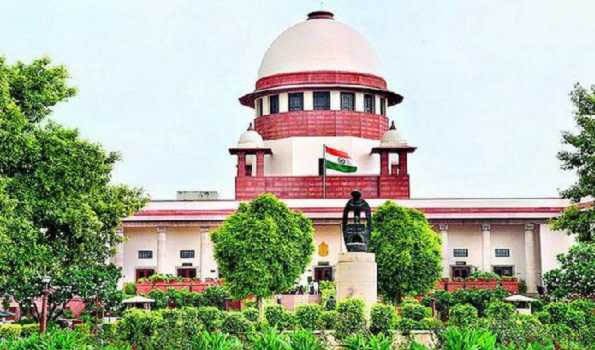
New Delhi, Jan 7 (UNI) The Supreme Court on Wednesday took up for hearing a batch of matters on the management of stray dogs and public safety. A bench comprising Justices Vikram Nath, Sandeep Mehta and NV Anjaria observed that the court would hear all stakeholders, including victims of dog attacks as well as animal lovers.
At the outset, Justice Vikram Nath remarked, “We will hear everyone today. We will hear the victims, then the haters and the lovers both.” The matter had been listed earlier, but could not be taken up. On the previous occasion, when senior advocate Kapil Sibal sought an early hearing citing “very inhumane” treatment of dogs at the ground level, Justice Sandeep Mehta had observed that the court would play a video at the next hearing and ask, “what is humanity?”
The bench recalled that on November 7 last, the Supreme Court had directed the removal of stray dogs from institutional premises such as schools, hospitals, sports complexes, bus stands and railway stations. The court had ordered that such dogs be relocated to designated shelters after due sterilisation and vaccination, and specifically directed that dogs picked up from such places should not be released back at the same location.
Solicitor General Tushar Mehta submitted that the debate often gets polarised, observing, “There are those who appear for dogs, and those who appear for humans.”
Amicus Curiae senior advocate Gaurav Aggarwal informed the court that pursuant to the November directions, the Animal Welfare Board of India (AWBI) had framed and circulated Standard Operating Procedures (SOPs).
He said stray animals from national highways and vulnerable stretches were required to be removed to prevent accidents, and the National Highways Authority of India (NHAI) had identified vulnerable stretches where animal ingress was frequent.
Justice Vikram Nath, however, suggested that fencing could be an effective solution. Justice Mehta added that fencing was being done on super expressways, and highlighted recent incidents involving Rajasthan High Court judges, noting that one judge was still suffering from serious medical issues following an accident involving stray animals.
The amicus pointed out that creation of shelters and the functioning of Animal Birth Control (ABC) centres were two distinct issues. He stressed the need for adequate infrastructure within municipal corporations, optimal sterilisation particularly of male dogs, as recommended by AWBI and compliance by states through affidavits.
He informed the court that affidavits had not been filed by Madhya Pradesh, Uttar Pradesh, Punjab and Karnataka, calling them “four big states”.
He added that some affidavits received were “very disappointing” and did not clearly spell out infrastructure capacity, steps to prevent animal ingress on highways, or shelter availability.
Taking Maharashtra’s affidavit as an example, the amicus stated that while some data had been provided such as removal of dogs from government medical colleges, the affidavit did not adequately explain the overall capacity of ABC centres or long-term measures.
Advocate Vandana Jain, who has filed a modification application, submitted that nearly 55,000 people are bitten by dogs, asserting that public safety cannot be ignored. Describing herself as both a dog lover and a human lover, she said strict implementation of ABC rules, as directed by the court earlier, had not been carried out by the Madhya Pradesh government.
She identified two core problems: dog population and the lack of public awareness. She stressed the need for citizen participation, education on sterilisation programmes, and responsible animal care. She also sought transfer of a matter pending before the Madhya Pradesh High Court.
Solicitor general Tushar Mehta further argued that decisions on animals in gated communities should be left to the residents. He suggested that if a substantial majority of residents felt that free roaming of dogs posed risks to children, a democratic mechanism such as voting should be permitted to decide the issue.
Another counsel appearing for an applicant submitted that while there was no opposition to dogs per se, the menace of stray dogs had reached alarming levels, claiming the dog population was around 6.2 crore.
It was argued that the existing ABC rules require reconsideration and may be contrary to the parent statute. The matter remains under consideration as the Supreme Court continues to hear diverse viewpoints balancing animal welfare and human safety.