




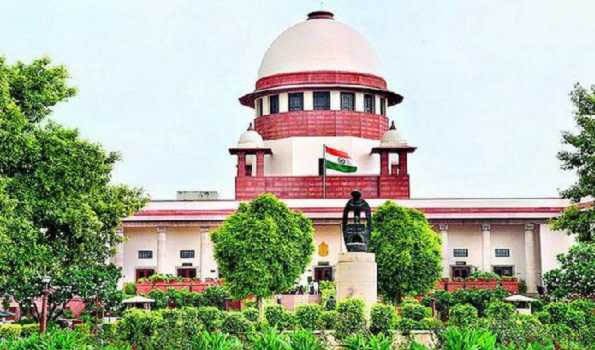
New Delhi, Jan 6 (UNI) The Supreme Court on Tuesday permitted certain part-time teachers from West Bengal to submit a fresh representation before the Secretary of the State’s School Education Department seeking parity in pay with full-time teachers working in non-government aided higher secondary schools.
A Bench comprising Justice Vikram Nath and Justice Sandeep Mehta directed that the representation, if filed, be considered in accordance with law and decided by a reasoned order within four months.
Reading out the operative portion of the judgment in open court, Justice Mehta granted liberty to the petitioners to approach the Secretary within six weeks, placing on record their grievances, claims, and entitlements in terms of earlier High Court orders.
The Court further directed that the petitioners be granted an opportunity of hearing in a representative capacity and that relevant records relating to their engagement be summoned from the concerned schools for inspection. In the event of an adverse decision, the petitioners were left free to pursue remedies available under the law.
Justice Nath remarked, “Don’t come here! Go to the appropriate forum.” He said this after the operative directions were read out.
The matter originated when the State Government passed an order on July 28, 2010, which extended the benefit of 10 days’ casual leave and 10 days’ medical leave to contractual part-time teachers, subject to the condition that they would take the same number of classes per week as regular full-time teachers.
Alleging discriminatory treatment, certain part-time teachers approached the Calcutta High Court seeking parity with regular teachers, including equal pay for equal work.
While the State authorities had earlier rejected the claim on the ground that part-time teachers were appointed on a purely contractual basis and that no policy existed for their regularisation, a Single Judge of the High Court later allowed the writ petition, applying the principle of equal pay for equal work and directing payment of salary and benefits at par with full-time teachers with effect from April 27, 2007.
The State subsequently challenged that decision, leading to further proceedings and, ultimately, the present order of the Supreme Court granting liberty to make a fresh representation before the competent authority.