





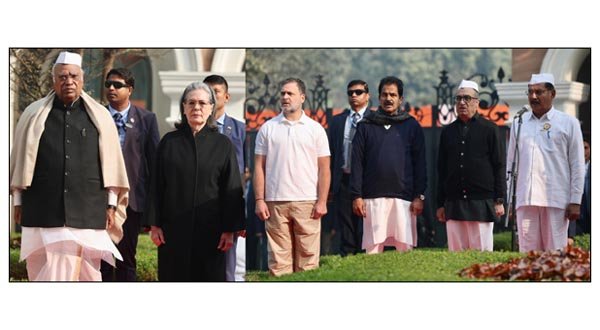
New Delhi, Dec 28 (UNI) The Congress on Saturday marked its 140th Foundation Day with a strong message of commitment to constitutional values, democratic institutions and social justice, as the party president addressed Congress workers across the country, recalling the organisation’s long role in India’s freedom struggle and nation-building.
Extending greetings to Congress members nationwide on the occasion, the party chief Mallikarjun Kharge also conveyed advance New Year wishes and remembered the sacrifices made since the party’s founding on December 28, 1885, in Mumbai. The address noted that for over six decades, millions associated with the Congress fought British rule, endured imprisonment and hardship, and laid down their lives before India finally attained freedom.
Paying tribute to the makers of modern India and freedom fighters, the Congress president said the party would continue striving to realise the vision of those who laid the foundations of the Constitution and a strong democratic system. The speech underlined that many of the country’s tallest leaders, including Mahatma Gandhi, were shaped within the Congress tradition, which mobilised farmers, workers, women and the poor under the banner of the national movement.
Referring to the 1931 Resolution, the Congress chief recalled that the framework of fundamental rights adopted by the party before Independence later became part of the Constitution. However, concern was expressed that both the Constitution and democracy are under threat today.
The address highlighted the sacrifices of leaders such as Mahatma Gandhi, Indira Gandhi and Rajiv Gandhi, who laid down their lives in defence of India’s core values of unity, secularism and social justice. It also noted several historic milestones, including the centenary of Mahatma Gandhi becoming Congress president, 75 years of the adoption of the Constitution, and the 150th anniversary of Vande Mataram. Looking ahead, 2026 will mark the bicentenary of Dadabhai Naoroji, the centenary of Sarojini Naidu’s Congress presidency, and 100 years of the patriotic song ”Jhanda Uncha Rahe Hamara” first sung at the 1925 Kanpur Congress session.
Drawing a contrast with other post-colonial nations, the Congress president said that while many countries that gained freedom around 1947 later slipped into authoritarianism, India remained a vibrant democracy because of Congress leadership. The party’s role in transforming India’s global standing in agriculture, space, nuclear science and strategic sectors was also highlighted.
The speech credited successive Congress governments with landmark changes, from the Green and White Revolutions to economic liberalisation, and advances in education, information technology and services. Special reference was made to the UPA years under Sonia Gandhi’s leadership and Dr Manmohan Singh’s tenure as Prime Minister, during which rights-based laws such as RTI, RTE, MGNREGA, the Food Security Act, Forest Rights Act and land acquisition reforms were enacted.
At the same time, the Congress president accused the BJP-led government of the past 11 years of weakening institutions built over decades, undermining labour welfare schemes like MGNREGA, and favouring select corporate interests. Concerns were raised over environmental exploitation, alleged manipulation of official data and the delay in conducting the Census.
Calling on party workers to remain united, the Congress chief urged them to reach out to people across the country to defend MGNREGA and constitutional rights, invoking the spirit of historic movements such as the Dandi March and Quit India Movement.
Concluding the address, the party president rejected claims that the Congress has lost relevance, asserting that while political power may fluctuate, the party’s ideological spine remains intact. ”Congress is an idea, and ideas never die,” the leader said, adding that the present struggle is not merely electoral but a fight to protect the soul of India, its Constitution and its democracy.