




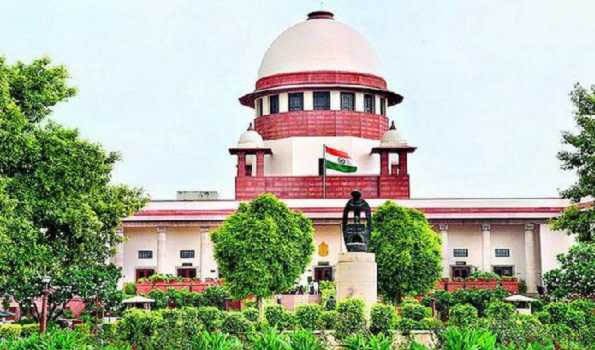
New Delhi, Dec 17 (UNI) The Supreme Court on Wednesday declined to entertain pleas challenging the Delhi Government’s decision to suspend physical classes from Nursery to Class 5 because of severely deteriorated air quality in the national capital.
A Bench comprising Chief Justice of India Surya Kant, Justice Joymalya Bagchi and Justice Vipul Pancholi observed that it was not inclined to intervene as the suspension of classes was only a temporary measure and schools were anyway scheduled to close next week for winter vacations.
The Court, however, left the issue open for consideration by the Commission for Air Quality Management (CAQM).
Senior Advocate Menaka Guruswamy, appearing for economically weaker parents, submitted that the closure of schools disproportionately affected poor families, as children would be deprived of midday meals.
She questioned the rationale behind the decision, arguing that school children were not contributors to pollution and pointed out that many parents continued to work outdoors despite hazardous air quality.
Guruswamy further contended that the air inside homes was not necessarily better than that in classrooms and referred to the Court’s earlier observations suggesting that a hybrid option be made available to parents.
According to her, the present arrangement benefited only affluent families who could afford to keep children at home.
During the hearing, the Chief Justice observed that courts cannot act as “super specialists” and sit in appeal over decisions taken by experts.
The CJI noted that the closure was for a limited period and coincided with the imminent winter vacation.
Senior Advocate Siddharth Luthra, appearing for parents seeking a hybrid learning option, submitted that children were required to step out early in the morning, when pollution levels were at their peak, whereas people generally avoided outdoor activities before noon.
The Chief Justice, however, remarked that a hybrid model could itself lead to discrimination, as “those who can afford digital devices will safeguard themselves and those who cannot will expose themselves.”
Senior Advocate Aparajita Singh, the amicus curiae in the matter, informed the Bench that while hybrid classes were contemplated under the GRAP-IV measures notified by the CAQM, the Delhi Government went a step further by ordering complete suspension of physical classes up to Class 5. She said the idea behind hybrid learning was to strike a balance.
Additional Solicitor General Aishwarya Bhati, appearing for the Government of the National Capital Territory of Delhi, submitted that the decision was taken on December 15 when a thick layer of smog engulfed the city, pushing the Air Quality Index to alarming levels.
She stated that the measure was aimed at safeguarding the health of young children and would also help ease traffic congestion.
Responding to these submissions, Guruswamy reiterated that children from poor families were not contributing to pollution, as many of them walked to school.
The amicus curiae pointed out that in the past, similar applications had been forwarded by the Court to the CAQM for consideration. However, the Bench chose not to intervene in the present case.
“We have heard the senior counsel regarding the direction sought for the closure of schools and holding classes online.
We are informed that schools for children from nursery to Class 5 are closed temporarily, and the winter break will commence soon.
Hence, there is no need for this Court to intervene,” the Bench observed while declining interference.