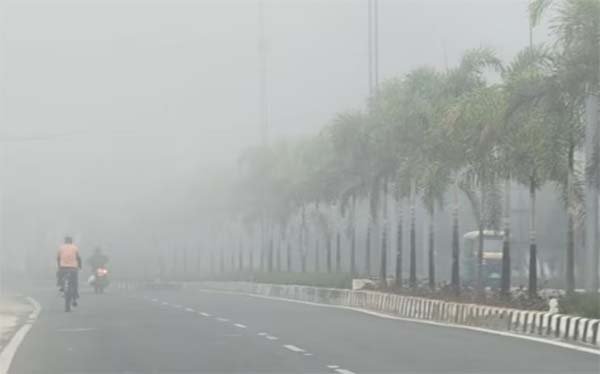






New Delhi, Dec 17 (UNI) New Delhi witnessed reduced visibility on Wednesday morning as shallow fog and mist enveloped parts of the city, according to official observations.
Safdarjung recorded the lowest visibility of 900 metres in shallow fog at 6:30 am IST, while Palam reported 1,100 metres in mist at 7:00 am IST. Westerly winds blowing at 7–10 kmph helped prevent a sharper deterioration in visibility.
Flight and road operations remained largely unaffected, though the India Meteorological Department (IMD) advised motorists to exercise caution during early morning hours.
Meanwhile, air quality in the national capital remained in the ‘Very Poor’ category. Delhi’s overall Air Quality Index (AQI) stood at 329 at 6:05 am, based on data from 39 of the 40 monitoring stations.
Several areas recorded significantly high pollution levels, with Mundka (371), NSIT Dwarka (361), Nehru Nagar (360), Okhla Phase-2 (339), Punjabi Bagh (340) and Narela (340) reporting AQI in the very poor range.
North Campus, DU recorded an AQI of 319, while Najafgarh stood at 305, Anand Vihar recorded an AQI of 341 whereas Ashok Vihar’ AQI level was 351 and DTU’s AQI measured 358.
Health advisories warned that prolonged exposure to such air quality could cause respiratory discomfort, particularly for children, the elderly and those with pre-existing conditions.
According to the AQI calendar for December, pollution levels have remained persistently high in recent days, with AQI touching 461 on December 14 and 427 on December 15, indicating sustained poor to very poor air quality across the city.
The India Meteorological Department (IMD) measures fog in terms of visibility: 500–1,000 metres is classified as shallow fog, 200–500 metres as moderate fog, and below 200 metres as dense fog.
Meteorological conditions are expected to improve gradually as the day progresses with rising temperatures and increased sunlight, which may help disperse fog and pollutants.
Delhi’s AQI stays ‘Very Poor’, fog reduces visibility across parts of city