




Bengaluru, Dec 11 (UNI) Hitachi Construction Machinery on Thursday said global headwinds such as renewed Trump-era tariffs in the United States and the depreciation of the Indian rupee are reinforcing the company’s confidence in India, which is emerging as a strong and stable pillar in its long-term international strategy.
Hitachi Construction Machinery, Japan President and COO Masafumi Senzaki, interacting with the media, said the company views India not merely as a high-growth market but as a strategic base that will help the group navigate global uncertainties while expanding its innovation and manufacturing footprint.
Hitachi, the world’s No. 1 excavator manufacturer, restarted its independent US operations in March 2022 after ending its earlier joint venture. Senzaki said the company has since rebuilt its dealer network and expanded to around 10 percent market share in America, and despite the tariff environment, Hitachi expects to continue growing steadily by adding about two percentage points in share every year.
He noted that Europe is showing a healthy recovery, barring the UK, and Asian markets remain stable, giving the company a broad-based growth platform.
However, he emphasised that India is becoming the most important stabiliser in Hitachi’s global playbook. With the Tata–Hitachi joint venture dating back to 1982, the Indian operations now contribute the highest machine volumes for the group.
Tata Hitachi MD Sandeep Singh said the company’s two plants at Dharwad and Kharagpur have achieved 65 to 80 percent localisation, significantly strengthening cost competitiveness.
Singh acknowledged that rupee depreciation adds pressure to import components, but he said the same currency trend has opened up new export advantages. Tata Hitachi’s exports have nearly doubled from 300–350 machines last year to an estimated 500–600 units this year, with strong traction in the Middle East, Africa and Southeast Asia. Exports of backhoe loaders have also risen.
Although the current export scale does not fully offset higher import costs, Singh said the company sees steady growth opportunities once India’s forthcoming excavator emission regulations align domestic products with global standards, enabling deeper international penetration.
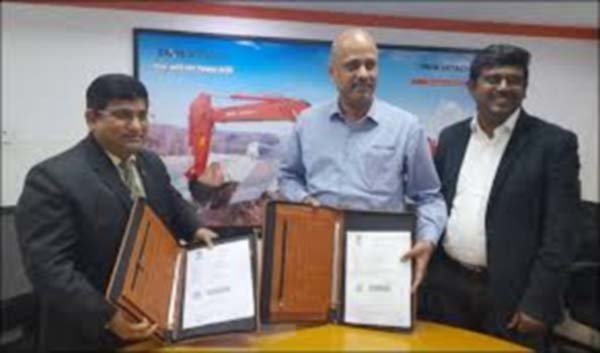
A major forward-looking step is the establishment of the India Development Centre (IDC), which Singh described as a milestone for both the company and India’s engineering ecosystem. For the first time, Hitachi is co-developing global products with India at the concept stage, instead of merely adapting Japan-designed platforms. Engineers from the IDC are already working closely with teams in Japan and will contribute to Hitachi’s 2030 technology roadmap.
Singh added that India is also becoming an important base for advanced technologies in the construction sector. While diesel remains the dominant fuel due to site conditions, electric solutions are gaining ground in mining.
Hitachi has supplied electric dump trucks and cable-powered large excavators to Coal India and other operators, signalling a gradual shift towards cleaner energy options.
On skills and employment, Tata Hitachi continues to expand training through its Kharagpur and Dharwad centres, along with ITI collaborations, apprenticeship programmes and Indo–Japan skill development initiatives. Singh said these programmes are building a strong talent pipeline that supports both industry needs and youth employment.
Despite global uncertainties linked to tariffs and currency fluctuations, Hitachi executives said the company remains optimistic. India’s infrastructure expansion, cost-efficient manufacturing, strong supplier base and engineering capabilities are positioning the country as a long-term growth engine for Hitachi Construction Machinery worldwide.
Tata Hitachi banks on India amid Trump tariffs, weak rupee