




Cuttack, Dec 9 (UNI) India’s total of 175 for six on Tuesday evening at the Barabati Stadium looked far more imposing than it once threatened to be, and that transformation owed itself almost entirely to one man.
For nearly 12 overs, the innings had meandered uncertainly, weighed down by early wickets and hesitant shot-making.
The South African pace trio of Lungi Ngidi, Marco Jansen and Anrich Nortje had probed the deck hard enough to keep India tethered to a modest trajectory. Then Hardik Pandya walked in, and the mood, the tempo and the complexion of everything that followed changed as if the floodlights themselves had shifted hue.
What Hardik produced over the next 45 minutes wasn’t merely a counterattack; it was a reassertion of identity. Long before injury breaks softened his swagger and leadership discussions clouded his role, Hardik Pandya was cricket’s purest momentum-breaker, someone capable of bending innings to his will. On a cool December night in Cuttack, he reminded a full house exactly why.
India were 78 for four when he arrived — neither collapsing nor cruising, just stuck. Tilak Varma’s laboured stay (26 off 32) had absorbed deliveries without generating threat. The boundaries had thinned out. South Africa sensed control. Even the typically loud Barabati crowd had settled into a quiet wait.
Then came the thump.
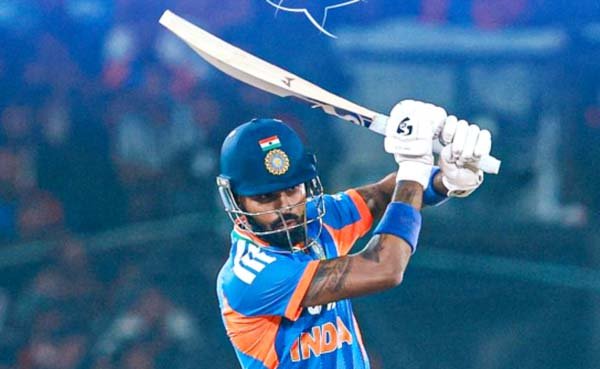
Hardik’s first act of declaration arrived against Keshav Maharaj in the 12th over. Maharaj tossed one up invitingly, and Hardik responded by clearing his front leg and launching it straight back over long-on.
The next ball received even harsher treatment — another clean arc of the bat, another six in the same region. It wasn’t just the runs; it was the unmistakable message that he had located his rhythm early.
Lutho Sipamla attempted the short-ball plan. Hardik slapped one over the bowler’s head with a shot that carried the easy arrogance of a forehand winner, then stood tall to lift him over long-off for six to bring up India’s 150. The fans erupted in synchrony, sensing that a simmering innings had just turned combustible.
But it was the 19th over that sealed the night’s narrative.
Facing Nortje, who had been cranking up pace near 150 kph, Hardik first reached his fifty — and did so in a manner that captured the essence of his batting. A ball outside off, not quite short enough to cut, not really in the slot to drive. He waited that fraction longer and sliced it deliberately over third man for six, as if adjusting mid-swing to manufacture a scoring option. The landmark was secondary; the audacity was the point.
Two balls later, he leaned into a length delivery and muscled it over mid-on for four, sending Nortje past 40 runs and sending the crowd into a rolling wave of noise. It wasn’t slogging; it was controlled violence.
In between, he survived a miscued loft that fell between Tristan Stubbs and Dewald Brevis — a reminder that all great innings have their slivers of fortune — before resetting and continuing the charge. Jitesh Sharma’s swivel-pulled six earlier in the over had already ignited the final-phase surge, but the innings belonged to Hardik entirely.
By the time India reached 175 for six, Hardik had stroked 59 not out off 28 balls, hitting six fours and four sixes. More than the numbers, it was the sense of inevitability he created — the feeling that the innings was being shaped by a player seeing the game one frame earlier than everyone else.
For India, this knock came at a time when their T20 batting identity is in flux. New openers, shifting middle-order choices, and the constant churn around the finishing role have created uncertainty. Hardik’s innings sliced through that haze. It was vintage yet refreshed, instinctive yet composed.
As the players walked off, South Africa knew the scoreboard read 175. India knew the same. But the fans walking out of Barabati felt something different: that they had just seen Hardik reclaim the version of himself cricket has been eager to see again.