





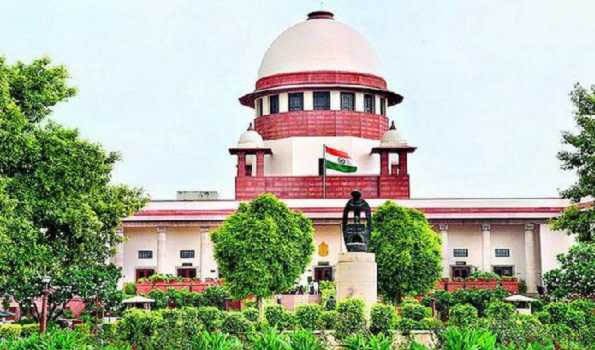
New Delhi, Dec 9 (UNI) The Supreme Court on Tuesday issued notice to the Election Commission of India (ECI) and the State of West Bengal on a petition filed by Sanatani Sangsad seeking deployment of State police officers under the ECI’s deputation until the final publication of electoral rolls after the ongoing Special Intensive Revision (SIR) in the State.
The petition also seeks, in the alternative, deployment of central armed forces for the duration of the SIR, citing alleged attacks on Booth Level Officers (BLOs) conducting door-to-door verification.
A Bench of Chief Justice of India Surya Kant and Justice Joymalya Bagchi heard the plea.
Senior Advocate V. Giri, appearing for the petitioner, claimed that BLOs in West Bengal were facing violence while performing SIR duties and argued that the deployment of Central forces was necessary to ensure their safety.
“The BLOs should be given protection,” he submitted, pressing for interim directions.
However, Justice Bagchi noted that apart from a single FIR cited in the petition, there was no substantial evidence of widespread obstruction.
“Except for one FIR, nothing else is shown. The other instances referred to are historical. The materials are presumptive,” Justice Bagchi observed.
ECI said that the State police is responsible, but deputation is possible if needed.
Senior Advocate Rakesh Dwivedi, representing the ECI, stated that law and order remain with the State police, and the ECI expects cooperation.
“The State government is supposed to give us protection. If it refuses, we have no option but to take the local police under deputation. If we cannot trust the police, we will have to take the Central forces,” he said.
He added that the ECI had already written a strong letter to the State, citing instances of BLOs and Electoral Officers being obstructed.
The Bench repeatedly emphasised that directions could not be issued based on newspaper reports and political narratives.
Justice Bagchi said, “We are sympathetic to your cause, but we must know whether this situation is unique to West Bengal. The only forensic evidence before us is one FIR. Can we issue State-specific directions on that basis?”
He also expressed concern about the workload on BLOs but clarified that the Court’s focus was ensuring the SIR process proceeds “on the ground without glitches.”
CJI Kant added, “If BLOs are being threatened, it is a serious issue. Had the ECI approached us, we would have considered it. But we cannot act on isolated instances.”
While issuing notice, the Court asked the ECI to submit its response, not only regarding West Bengal but also concerning the level of cooperation it is receiving from different States during the SIR process.
CJI Kant observed, “Let us hear from the ECI. Tell us not only about West Bengal but about the cooperation, or lack thereof from other States.”
Dwivedi assured the Court that the ECI would take strong steps if State cooperation falls short, adding that the Commission has the power to request central paramilitary support. However, he acknowledged that the ECI had not yet invoked such powers due to the “sensitive nature” of the issue.
The Court will hear the matter next after receiving responses from the ECI and West Bengal.