





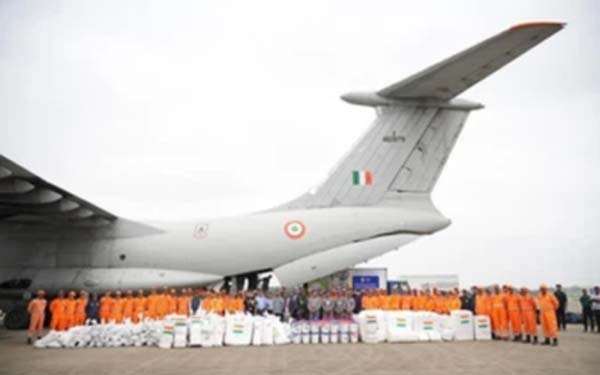
Thiruvananthapuram, (UNI) The Indian Air Force (IAF) continued its critical Humanitarian Assistance and Disaster Relief (HADR) operations in Sri Lanka for the third consecutive day today, as part of Operation Sagar Bandhu.
The ongoing mission aims to support communities severely affected by recent floods and landslides in several regions of the island nation.
According to official sources, the IAF air-dropped 5,860 kg of relief material in Kegalle and Kotmale on the third day of operations. In addition, IAF helicopters rescued 91 stranded citizens, including 70 adults and 21 children, from affected areas in Kotmale and Inguruwatta.
Additionally, five individuals were evacuated from remote, inaccessible locations through winching operations.
India and Sri Lanka share centuries-old civilizational, cultural, and maritime ties that have evolved into a robust partnership grounded in mutual trust and regional cooperation.
Humanitarian assistance has long been a key pillar of this relationship, with India consistently acting as Sri Lanka’s first responder during crises.
India’s HADR support dates back nearly 65 years, beginning with flood-relief assistance using Bell 47G helicopters in December 1957. A landmark moment came during the 2004 Indian Ocean Tsunami, when India launched Operation Rainbow, deploying naval ships, aircraft, medical teams, and engineering units within hours of the disaster. The mission became a benchmark for India’s regional disaster-response capability.
Over the years, India has continued to extend timely assistance during multiple emergencies in Sri Lanka, including the 2010 floods, 2016 floods and Cyclone Roanu, and the 2017 floods and landslides, reaffirming its growing operational readiness and humanitarian commitment.
The IAF’s ongoing relief operations underscore India’s unwavering support for the safety and well-being of its close maritime neighbour.
Anchored in the vision of SAGAR (Security and Growth for All in the Region), India remains committed to strengthening resilience and security across the Indian Ocean Region (IOR).