




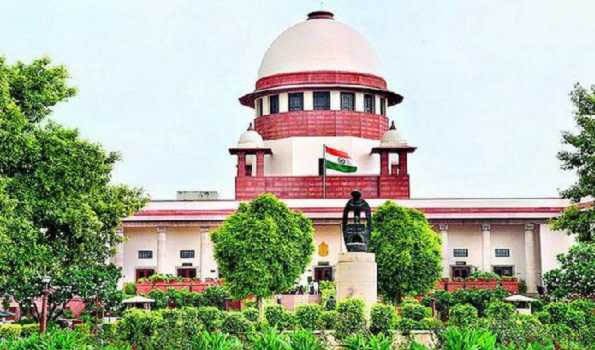
New Delhi, Dec 1 (UNI) The Supreme Court on Monday questioned the growing tendency to single out farmers for Delhi’s recurring air pollution crisis, observing that stubble burning existed even during the Covid-19 lockdown when the Capital witnessed exceptionally clear skies.
Hearing the long-pending MC Mehta matter on air pollution in the National Capital Region, a Bench comprising Chief Justice of India Surya Kant and Justice Joymalya Bagchi cautioned that the narrative around stubble burning must not be converted into “a political issue or an issue of ego,” reiterating that Delhi’s toxic air has multiple sources.
Addressing the union government, the CJI asked for clarity on scientific analyses identifying the primary contributors to pollution.
He noted that while stubble burning continues to be highlighted, it would be “incorrect to burden people who are hardly represented in Court,” adding that if stubble burning persisted even during Covid, the real question is why clear blue skies were still visible at that time.
The Court stressed that farmers often burn stubble to protect their livelihoods and should not be unfairly blamed.
The Bench directed the Centre to submit, within a week, a detailed report on effective measures taken to curb all major pollution sources other than stubble burning.
The Court further pressed the government to explain whether its action plans have produced tangible improvements, asking why the plans cannot be revisited and what impact each measure was expected to achieve.
Appearing for the Centre, ASG Aishwarya Bhati informed the Court that action-taken reports from Punjab, Haryana and the CPCB would be filed shortly.
She acknowledged that while the goal remains “zero burning,” the issue is only seasonal and that vehicular emissions and industrial dust based on IIT studies from 2016 and 2023, remain among the largest pollution contributors.
Justice Bagchi also questioned the effectiveness of the construction ban, pointing out that construction activity remains a significant source of dust pollution.
The Bench sought details on the expertise and qualifications of members of the Commission for Air Quality Management before proceeding further.
During the hearing, a counsel highlighted the problem of rampant roadside parking, noting that Delhi’s vehicle density surpasses that of many major metro cities combined.
The CJI observed that metro expansion may provide long-term relief but emphasised that immediate, short-term measures are equally crucial.
Another counsel recalled that Justice Kuldeep Singh’s orders in the 1990s directing the adoption of CNG buses had substantially improved air quality and urged similar decisive steps today.
The matter will be taken up next on December 10.