

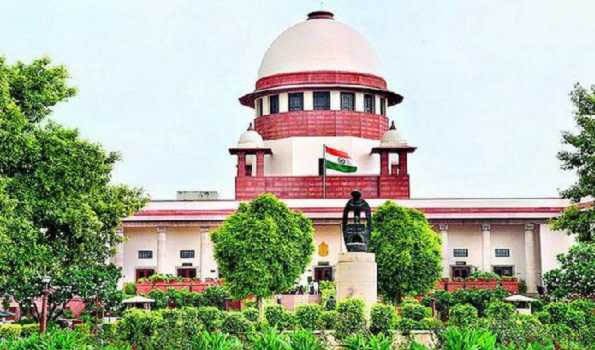
New Delhi, Nov 27 (UNI) The Supreme Court on Thursday underscored the need for a “neutral, independent and autonomous” regulatory body to oversee obscene, offensive or illegal content on digital platforms, expressing dissatisfaction with the current self-regulation framework adopted by media and OTT entities.
A bench comprising Chief Justice of India Surya Kant and Justice Joymalya Bagchi was hearing petitions filed by podcaster Ranveer Allahabadia and others seeking the clubbing of FIRs linked to allegedly obscene content in the online show “India’s Got Latent.”
Earlier, the court had widened the scope of the case to frame broader guidelines on online obscenity.
Attorney General R. Venkataramani and Solicitor General Tushar Mehta informed the court that the union government is formulating new guidelines and consulting stakeholders.
Mehta said the matter concerns not merely “obscenity” but also “perversity” in user-generated content published on YouTube and similar platforms.
CJI Kant expressed concern about the absence of any regulatory framework for independent content creators.
“So I create my own channel, I am not accountable to anyone… somebody has to be accountable!” the CJI remarked. He added that although freedom of speech is vital, it cannot be stretched to justify “perversity.”
Senior Advocate Amit Sibal, appearing for the Indian Broadcast and Digital Foundation (IBDF), stated that the IT (Intermediary Guidelines and Digital Media Ethics Code) Rules, 2021 already provide a regulatory structure, though some provisions are under judicial scrutiny.
He said OTT platforms voluntarily implement content labelling, age classifications, and complaints’ redress through a body headed by Justice (Retd.) Gita Mittal.
However, the CJI expressed deep reservations about this model.
“Self-styled bodies will not help. Some neutral autonomous body, free from the influence of both exploiters and the State, is needed as a regulatory measure,” he said, questioning why violations persist if self-regulation is effective.
Justice Bagchi echoed this concern, warning about the rapid spread of harmful content.
“Once the scurrilous material is uploaded, by the time authorities react, it has gone viral to millions. How do you control that?”
When Advocate Prashant Bhushan raised the possibility of the misuse of terms like “anti-national,” Justice Bagchi countered with a hypothetical: “Suppose a video shows that a part of India is not a part of India what do you do then?”
CJI Kant also highlighted the impact of offensive content on marginalised communities, noting the “millions of victims” affected by humiliation and abuse online.
The CJI further observed that existing warnings, disclaimers and age labels are insufficient, stressing the need for robust age-verification mechanisms. SG Mehta remarked that some statements in “India’s Got Latent” were so gross that they could not be repeated in court.
The bench recommended the government publish draft guidelines for public comments and form an expert committee comprising domain specialists and individuals with judicial experience.
The court recorded the AG’s submission that the Ministry of Information and Broadcasting would soon release the proposed guidelines for public consultation.
An initial reference in the order to a “preventive mechanism” was later replaced with “effective mechanism” after Amit Sibal cautioned that the former might imply pre-censorship.
“We will not put our seal of approval on something that can gag free speech. We will only address the vacuum,” the CJI clarified.
The matter will be taken up after four weeks.
The bench is currently hearing three connected cases petitions filed by YouTubers Ranveer Allahabadia and Ashish Chanchlani for the clubbing of FIRs in the India’s Got Latent controversy, and a petition filed by SMA Cure Foundation.
Previously, the court had directed five comedians, including Samay Raina, to issue public apologies for making insensitive remarks about persons with disabilities, and had granted interim protection to Allahabadia, including the release of his passport. Chanchlani has interim protection from the Gauhati High Court.