






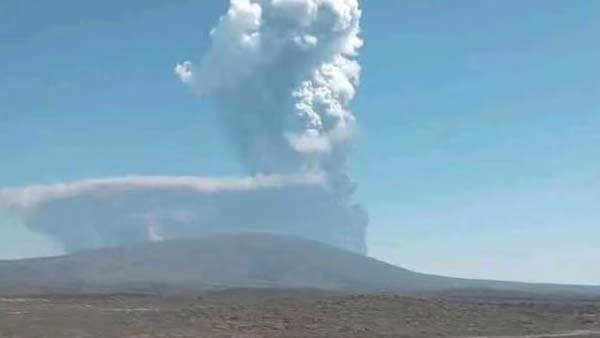
New Delhi, Nov 25 (UNI): At least seven international flights were cancelled and more than ten others were delayed at Delhi airport on Tuesday after ash plumes from a volcanic eruption in Ethiopia disrupted airline operations.
Since Monday, Air India alone has cancelled 13 scheduled flights.
Following the 23 November volcanic eruption in Ethiopia and the eastward movement of the ash cloud, MoCA, along with ATC, IMD, airlines, and international aviation agencies, is ensuring seamless coordination.
AAI has issued the necessary NOTAM, and all affected flights have been kept informed. Operations across India remain smooth, with only a few flights rerouted or descended as a precaution. There is no cause for concern at this time.
We continue to monitor the situation closely and will provide timely updates to ensure passenger safety.
Ash clouds from the recent eruption of Ethiopia’s Hayli Gubbi volcano are disrupting flight operations, with reports indicating that the clouds may be drifting toward western India.
A senior airport official said Delhi airport recorded seven international flight cancellations and twelve delays due to volcanic ash drifting into the region.
Indira Gandhi International Airport, the country’s largest aviation hub, handles over 1,500 flights daily.
As of Tuesday, other Indian carriers had not issued any updates on potential schedule changes.
The Directorate General of Civil Aviation (DGCA) on Monday instructed airlines to avoid volcanic ash-affected areas and flight levels and to update flight planning, routing, and fuel arrangements as per the latest guidance.
Meanwhile, a massive volcanic ash cloud generated by the Hayli Gubbi eruption in Ethiopia’s Afar region is moving eastward and is expected to exit Indian airspace by Tuesday evening, officials said.
While the ash poses no threat on the ground, its presence at altitudes between 8.5 km and 15 km (approximately 15,000–45,000 feet) has raised concerns for aviation safety.
The ash plume, carried by high-altitude winds, has already drifted over eastern Uttar Pradesh, Bihar, the northeastern region, and parts of Gujarat. Meteorological forecasts indicate that it will extend further into Rajasthan, northwest Maharashtra, Delhi, Haryana, Punjab, and eventually the Himalayan belt.
The India Meteorological Department (IMD) and Met Watch Offices in Mumbai, New Delhi, and Kolkata have issued ICAO-standard SIGMET warnings to airports, advising avoidance of affected airspace and specific flight levels as detailed in Volcanic Ash Advisory Center (VAAC) bulletins.
Airlines are relying on continuous monitoring of satellite imagery, dispersion models, and meteorological advisories to plan rerouting, fuel loads, and flight altitudes.
The DGCA has also issued a detailed safety advisory directing airlines to steer clear of designated ash-affected zones and adjust flight plans accordingly.
Aviation authorities have warned that volcanic ash can melt inside jet engines at extremely high temperatures, potentially causing severe engine damage or even failure.
Although Mumbai’s Chhatrapati Shivaji Maharaj International Airport does not lie directly beneath the densest part of the ash plume, flights linked to the city, including those over the Arabian Sea and Gulf routes, may still face disruptions.
Several Indian carriers, including IndiGo and Akasa Air, have already diverted or cancelled certain international flights, particularly services to Gulf destinations such as Jeddah, Kuwait, and Abu Dhabi.
Officials emphasised that the situation is being continuously monitored, and passengers are advised to check with airlines for updated flight schedules.