




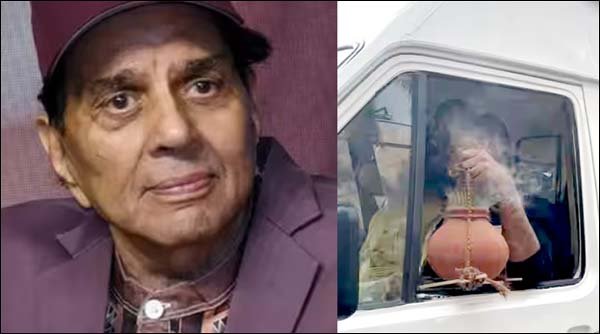
Mumbai/New Delhi, Nov 24 (UNI) Bollywood legend Dharmendra, one of the most beloved superstars in the history of Indian cinema, died at his Mumbai residence on Monday, plunging the country as well as his countless fans abroad into mourning.
Dharmendra, 89, who left behind his two wives including yesteryear’s leading Bollywood actress Hema Malini and six children, breathed his last at around 1 pm, his family announced.
Later, he was cremated with full honours at the Pawan Hans Crematorium in Vile Parle, amidst tearful scenes with a galaxy of film personalities, politicians and eminent persons from other fields turning up to pay their last respects.
Dharmendra, affectionately called the “He-Man of Indian Cinema,” had been battling age-related health issues for some time.
He leaves behind an extraordinary legacy spanning over six decades and more than 300 films.M
President Droupadi Murmu and Prime Minister Narendra Modi led the nation in paying homage to the departed actor.
President Murmu described Dharmendra’s death as “a great loss to Indian cinema”, acknowledging his lifelong contribution to Indian culture and film.
PM Modi said the actor’s demise “marks the end of an era in Indian cinema”, adding that Dharmendra brought unmatched charm, versatility, and sincerity to his performances.
The cremation witnessed deeply emotional scenes as members of the Deol family, close friends, and towering figures from the film industry gathered to bid their final farewell.
Dharmendra’s wife, actress and MP Hema Malini, and daughter Esha Deol arrived in traditional white attire, visibly grief-stricken. His son, actor Sunny Deol, performed the final rites as per tradition, supported by family members Bobby Deol, Ahana Deol, and Vijeta and Ajeeta Deol.
The funeral drew some of the biggest names in Indian cinema.
Amitabh Bachchan, who shared one of Bollywood’s most iconic partnerships with Dharmendra in the 1975 classic “Sholay”, arrived with his son Abhishek Bachchan and grandson Agastya Nanda, who had recently worked with Dharmendra in his final film “Ikkis”.
Among other Bollywood dignitaries were Aamir Khan, Salman Khan, Shah Rukh Khan, Ranveer Singh, Deepika Padukone, Sanjay Dutt, producer-writer Salim Khan, and director Rajkumar Santoshi. Many were seen consoling family members and recalling their personal memories of the actor.
Union Minister Nitin Gadkari, who shared a close personal bond with the actor, said the industry had lost “a very good and kind-hearted human being.”
The film fraternity expressed an overwhelming outpouring of grief.
Filmmaker Karan Johar described Dharmendra as “a massive mega star and the embodiment of a hero in mainstream cinema.”
Actress Kareena Kapoor Khan shared emotional photographs capturing Dharmendra alongside other legends, captioning them “Chardi Kala,” symbolising an ever-rising spirit.
Many actors, including Ajay Devgn, Kajol, Madhur Bhandarkar and Kiara Advani, and Ananya Panday, expressed their condolences on social media, remembering him as a warm and a loving person who inspired generations.
Born December 8, 1935, in Nasrali, Ludhiana district, Punjab, Dharmendra Kewal Krishan Deol hailed from a Punjabi Jat Sikh family.
In 1958, he won the Filmfare talent hunt — a life-changing victory that brought him to Mumbai. His early years were marked by struggle, perseverance, and a passion for cinema that carried him from small-town Punjab to the heart of Bollywood.
He made his film debut in ‘Dil Bhi Tera Hum Bhi Tere’ (1960), followed by supporting roles in ‘Boy Friend’ (1961) and ‘Bandini’ (1963). His breakthrough came in “Phool Aur Patthar” (1966) opposite Meena Kumari, which became the highest-grossing film of the year and earned him the title He-Man of Bollywood for redefining the action hero archetype.
From then on, Dharmendra became one of Indian cinema’s most versatile and bankable stars. His iconic performances in ‘Mera Gaon Mera Desh’ (1971), ‘Seeta Aur Geeta’ (1972), and ‘Sholay’ (1975) solidified his legendary status. His portrayal of Veeru in Sholay, alongside Amitabh Bachchan, remains one of Indian cinema’s most beloved roles.
The film’s enduring friendship anthem “Yeh Dosti Hum Nahin Todenge” continues to resonate with audiences.
Equally adept in comedy and drama, he delivered timeless performances in ‘Satyakam’ (1969), regarded as his career’s finest, and ‘Chupke Chupke’ (1975), showcasing his remarkable comic flair.
His filmography through the 1970s and 1980s includes enduring classics like ‘Yaadon Ki Baaraat’, ‘Jugnu’, ‘Loafer’, ‘The Burning Train’, and ‘Hukumat’.
In the later decades, Dharmendra gracefully transitioned into character and supporting roles. His performances in ‘Life in a Metro’ (2007), ‘Apne’ (2007) with his sons, and ‘Yamla Pagla Deewana’ (2011) endeared him to new generations.
He continued acting into his late 80s, appearing in ‘Rocky Aur Rani Ki Prem Kahani’ (2023) and ‘Teri Baaton Mein Aisa Uljha Jiya’ (2024). His final film, ‘Ikkis’, directed by Sriram Raghavan and co-starring Agastya Nanda and Jaideep Ahlawat, is set for release on December 25, 2025, marking his posthumous farewell to the silver screen.
Dharmendra received the Filmfare Lifetime Achievement Award (1997) and was honoured with the Padma Bhushan (2012) for his contribution to Indian cinema.
Beyond films, Dharmendra briefly entered politics, winning the 2004 Lok Sabha elections from Bikaner as a BJP candidate.
Dharmendra married Prakash Kaur in 1954, with whom he had four children — Sunny, Bobby, Vijeta, and Ajeeta. Later, he married actress Hema Malini in 1980, with whom he had two daughters, Esha and Ahana.
In his later years, Dharmendra led a serene life at his Khandala farmhouse, often sharing heartfelt messages and glimpses of rural tranquillity on social media. He remained physically active, was fond of swimming, gardening, and morning walks, encouraging fans to “stay fit and stay positive.”