






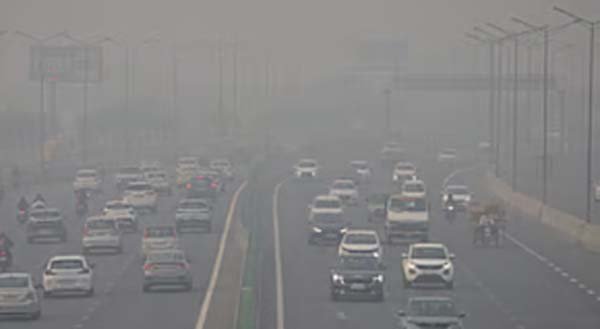
New Delhi, Nov 8 (UNI) The national capital continued to witness the impact of cold northwesterly winds on Saturday, as a faint smell of smoke lingered in Delhi’s air from morning to evening. Stubble smoke from Punjab and Haryana deteriorated Delhi’s air quality, which entered the deep end of th ‘very poor’ category.
Delhi’s 24-hour average air quality index (AQI) stood at 366 (very poor) at 4 pm on Saturday, up from 322 a day earlier, according to Central Pollution Control Board data.
For Saturday, data from the Decision Support System (DSS) under the Ministry of Earth Sciences (MoES) has forecast a likely contribution of 30.9 per cent from stubble burning to Delhi’s total PM2.5 concentration. However, the DSS did not update the data on Saturday, factoring in the previous day’s fire count and wind patterns.
Out of Delhi’s 39 active monitoring stations, nine recorded an AQI in the severe category, while the rest were in the poor to moderate range. The worst air was reported from Anand Vihar, Jahangirpuri, and Mundka.
Particulate Matter (PM2.5 and PM10) remained the dominant pollutant behind the capital’s worsening air, CPCB’s 4 p.m. bulletin noted. Out of the 39 air quality monitoring stations across Delhi, 27 recorded ‘very poor’ air, while nine slipped into the ‘severe’ zone. The worst-hit areas included Wazirpur (420), Bawana (419), Burari (418), Vivek Vihar (411), Narela (406), Nehru Nagar (406), Alipur (404), ITO (402), and Jahangirpuri (402).
As per CPCB’s classification, an AQI between 301 and 400 is deemed ‘very poor’, while readings above 400 fall in the ‘severe’ range, posing serious health risks, especially for children, the elderly, and those with respiratory conditions.