




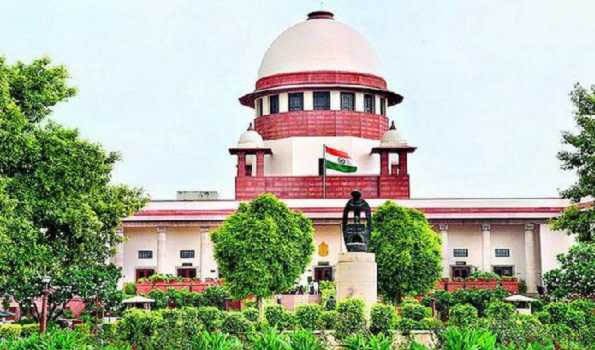
New Delhi, Nov 4 (UNI) The Supreme Court today expressed displeasure over the union government’s application seeking to refer the petitions challenging the Tribunals Reforms Act, 2021, to a five-judge Bench, questioning whether the move was a deliberate attempt to avoid the current bench that has already heard the matter extensively.
A bench comprising Chief Justice of India BR Gavai and Justice K. Vinod Chandran was hearing the long-pending Madras Bar Association case, which challenges the constitutional validity of the Tribunals Reforms Act, 2021.
During the proceedings, Attorney General for India R. Venkataramani, appearing for the Centre, informed the court that the union government had filed an application requesting that the matter be placed before a larger bench.
Expressing clear dissatisfaction, the CJI remarked, “We don’t expect the union of India to indulge in such a tactic.”
When the Attorney General urged the bench not to term it a “tactic,” the CJI responded, “It is… after we have heard one party fully, after we have accommodated the AG on personal grounds.”
The bench clarified that it would complete the hearing of the Union’s submissions, and only if it found sufficient merit would it consider referring the case to a larger bench.
Appearing for the petitioners, senior advocate Arvind Datar raised serious concerns regarding the appointment process for members of tribunals such as the Income Tax Appellate Tribunal (ITAT) and Central Administrative Tribunal (CAT).
He submitted that merit lists were often disbanded, and vacancies were being filled from waiting lists instead, undermining transparency and fairness.
Responding to these allegations, the Attorney General explained that selections are made considering multiple factors, and that many candidates decline appointments after being placed on the merit list.
He clarified that the union has never endorsed filling vacancies from the waiting list over the merit list, and that occasional deviations occur due to administrative contingencies.
The AG added, “We have to work in a system where people drop in, drop out.
Many candidates apply for several positions in different tribunals. Therefore, to say that we will only have one or two candidates to consider… I am only on that question, not on sacrificing merit.”
He further urged the Court to allow the new regime under the Tribunals Reforms Act to function for some time before passing judgment.
“Let the system work. Let the law gain some experience over time; these are issues that can be ironed out,” the AG submitted, arguing that minor administrative lapses should not lead to the striking down of the entire statute.
At this point, the CJI questioned the Attorney General on how his submission, that the law should be allowed to evolve, aligned with his simultaneous request for reference to a five-judge Bench.
“Are we wrong in creating an impression that the application is filed deliberately to avoid the matter?” the CJI asked.
The Attorney General refuted any such motive, asserting that there was “no attempt to avoid the Bench.”
He stated that the Act had been enacted after “extensive deliberations” and that its overall framework was constitutionally sound, even if certain implementation issues persisted.
The hearing also touched upon the minimum age requirement of 50 years for appointments as Chairperson or Member under the Act. Referring to his own judicial career, CJI Gavai observed that he was appointed as a High Court judge at the age of 42, and under the current Act’s criteria, he would have been deemed ineligible.
The Attorney General, however, maintained that tribunal appointments involve a different set of requirements and cannot be equated with High Court judgeships.
“Tribunals require a different kind of experience. Let’s not apply the same yardstick,” he said.
Earlier hearings have seen the petitioners, led by Senior Advocate Arvind Datar, challenge successive ordinances and statutory provisions issued by the government concerning the administration and service conditions of tribunal members, contending that these measures contravene earlier Supreme Court rulings safeguarding judicial independence in tribunal appointments.
The matter will be heard further on a later date.