






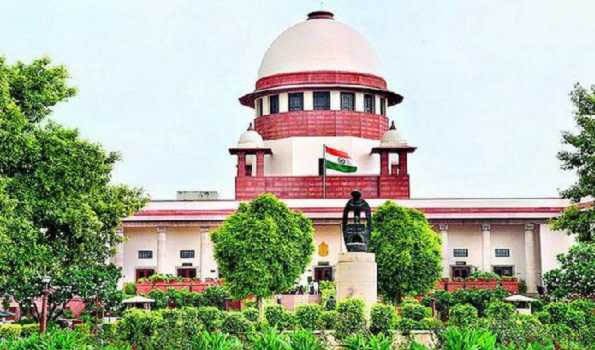
New Delhi, Oct 28 (UNI) The Supreme Court has restored criminal proceedings against former MLA Rajendra Singh, his father Amrik Singh, and others for allegedly obtaining a fraudulent Scheduled Caste certificate to contest the Guna Assembly election as a reserved category candidate.
A Bench comprising Justice B.V. Nagarathna and Justice K.V. Vishwanathan allowed the appeals filed by complainant Komal Prasad Shakya and others, setting aside the Madhya Pradesh High Court’s order dated June 28, 2016, which had quashed the criminal complaint and the trial court’s cognizance order.
The allegations involve cheating, forgery, and criminal conspiracy under Sections 415, 416, 420, 467, 468, 471, and 120B of the Indian Penal Code (IPC).
According to the complaint, Rajendra Singh obtained a Scheduled Caste certificate on August 8, 2008, from the Sub-Divisional Officer, Guna, falsely identifying himself as belonging to the ‘Sansi’ caste, a Scheduled Caste category.
Based on this certificate, he contested and won the Guna (SC reserved) Assembly seat.
However, the Caste Scrutiny Committee, by its order dated August 10, 2011, found the certificate to have been issued illegally and ordered its forfeiture.
The complaint further alleged that Rajendra Singh and his father, Amrik Singh, belonged to the General category and had always identified themselves as such.
It was only immediately before the election, the complaint claimed, that they fabricated documents and affidavits to secure a false caste certificate for electoral advantage.
While restoring the case, the apex court observed that the High Court had conducted a “mini-trial”, which was impermissible at the stage of exercising powers under Section 482 of the Code of Criminal Procedure (CrPC).
“We have also perused the order, taking cognizance. The trial judge has meticulously applied his mind and sifted the chaff from the grain and, out of twelve accused, has taken cognizance only against the four respondents-accused herein,” the Bench noted.
The Supreme Court refused to enter into the merits of the allegations to avoid prejudicing the accused during trial, but found the High Court’s reasoning to be speculative.
The High Court had earlier held that due to “legal illiteracy,” it was possible that, being members of the Sikh community, Rajendra Singh’s family might not have realised their eligibility for reservations.
The Supreme Court, however, termed this reasoning “conjectural and patently erroneous.”
It further held that the High Court’s finding that no evidence was produced was untenable, and its assumption that the accused were unaware of their caste identity was speculative.
Rejecting the contention that the complaint was a “witch-hunt,” the Court said such an argument was “too sweeping” in light of the Scrutiny Committee’s findings. The Bench also rejected the submission that offences of forgery (Sections 467, 468, 471 IPC) and cheating (Section 420 IPC) were not made out at this stage.
“At this stage, it cannot be said that there is a case for nipping the prosecution at the bud,” the Bench held, observing that whether the complainant can substantiate the allegations will depend on the evidence adduced at trial.
Accordingly, the Supreme Court restored the criminal complaint and the trial court’s cognizance order to the file of the Chief Judicial Magistrate, First Class, Guna, directing that the trial proceed from the same stage.
Considering that the complaint dates back to 2014, the Bench directed that the trial be concluded within one year, clarifying that it should proceed uninfluenced by the observations made by the High Court or the Supreme Court.
The complaint also names two other accused, Kiran Jain, a Councillor of Ward No. 16, and Harvir Singh of the Gurudwara Management Committee, Guna, who allegedly issued false certifications declaring that Rajendra Singh belonged to the Sansi caste, despite knowing otherwise.