



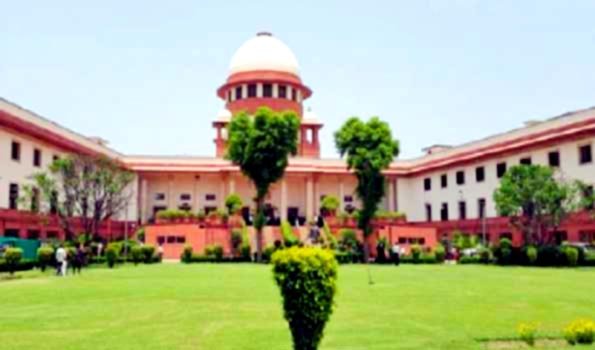
New Delhi, Oct 7 (UNI) In a relief for Gujarat Urja Vikas Nigam Limited (GUVNL), the Supreme Court has set aside the Appellate Tribunal for Electricity’s (APTEL) March 2025 judgment and restored the 2009 order of the Gujarat Electricity Regulatory Commission (GERC) in a long-pending dispute with Essar Power Limited (EPL) over diversion of electricity in violation of a 1996 Power Purchase Agreement (PPA).
A bench comprising Justice Sanjay Kumar and Justice Alok Aradhe partly allowed GUVNL’s appeal, ruling that EPL was contractually bound to maintain the stipulated 58:42 supply ratio 58% to GUVNL and 42% to Essar Steel Limited (ESL) and that deviation from this proportion constituted a breach of contractual obligations.
The bench held that GUVNL, having paid fixed charges for power capacity that was wrongfully diverted to ESL, was entitled to reimbursement of fixed charges as restitution, in addition to compensation for the shortfall in supply.
“The finding of GERC and APTEL that GUVNL is not entitled to reimbursement of fixed charges is, therefore, unsustainable,” the court observed.
“Once GUVNL did not receive the electricity for which such fixed charges had been computed and paid on a monthly basis, it was entitled to reimbursement thereof, not as compensation, but on the principle of restitution as such payment was not at all due from it.”
Restoring the February 18, 2009, order of the GERC, the court faulted APTEL for misinterpreting the PPA provisions and disregarding the commission’s reasoning.
It emphasised that “where a purchaser has paid fixed charges for capacity that was wrongfully diverted, principles of restitution demand that the amount be reimbursed.”
The case originated from a 1996 Power Purchase Agreement (PPA) between GUVNL’s predecessor, the Gujarat Electricity Board, and Essar Power Limited (EPL) for the purchase of 300 MW from EPL’s 515 MW power plant.
The remaining 215 MW was designated for supply to EPL’s sister concern, Essar Steel Limited (ESL), maintaining a 58:42 ratio between GUVNL and ESL.
Disputes arose when EPL allegedly diverted a larger share of power to ESL, reducing GUVNL’s allocation.
In 2016, the Supreme Court ruled that EPL must adhere to the agreed ratio, compensate GUVNL for diverted power using the HTP-1 energy charge method, and reimburse fixed charges for any portion of GUVNL’s share sold to ESL.
However, when the matter was remanded to GERC and later to APTEL for quantification, both forums denied reimbursement of fixed charges and relied instead on an hourly computation method prompting GUVNL to approach the Supreme Court once again.
In its detailed judgment authored by Justice Sanjay Kumar, the court clarified that GUVNL is entitled not only to compensation for the wrongful diversion but also to reimbursement of fixed charges paid for electricity that was never supplied.
The court drew a distinction between “compensation” and “reimbursement”, observing: “The very connotation of ‘compensation’ would imply a payment to make good the loss or damage suffered owing to a breach of obligation. Reimbursement of fixed charges, however, flows directly from the provisions of the PPA itself and is not merely traceable to breach by EPL.”
Questioning the computation method adopted by APTEL, the bench noted that since EPL had itself earlier endorsed the half-hourly computation method for operational convenience, it could not now oppose its use for determining the extent of power diversion.
“Having invited that methodology for supply of power so as to avoid installation of a circuit breaker, EPL cannot now fight shy of the same methodology being adopted for computation of excess power diverted to ESL from GUVNL’s share,” the court observed.
Allowing GUVNL’s appeal, the Supreme Court set aside APTEL’s judgment, restored GERC’s 2009 order, and directed the commission to undertake a fresh computation of dues owed to GUVNL in light of the clarified legal principles.
The ruling marks a significant win for GUVNL, reaffirming the binding nature of contractual supply ratios and the principle of restitution in power purchase disputes within India’s regulated electricity sector.