




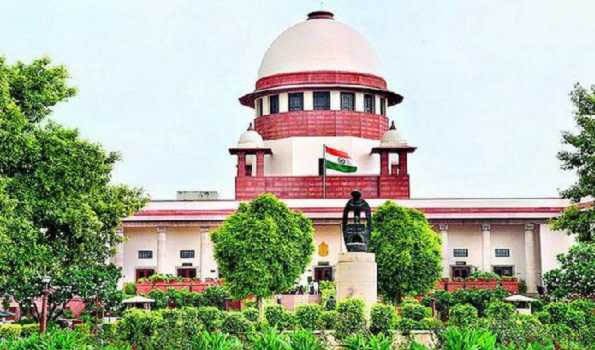
New Delhi, Sept 3 (UNI) A Special Leave Petition (SLP) has been filed in the Supreme Court challenging a 2022 judgment of the Kerala High Court that, while affirming the importance of the Sexual Harassment of Women at Workplace (Prevention, Prohibition and Redressal) Act, 2013 (POSH Act), adopted what petitioners call a “narrow and restrictive” interpretation of the law.
The petition, filed by Advocate Yogamaya M.G. under Article 136 of the Constitution, assails the High Court’s March 17, 2022 verdict.
According to the petitioners, the ruling has effectively excluded large categories of women in informal, freelance, or non-traditional work arrangements, particularly in the film, media, and political sectors, from the protection of the Act.
The plea stresses that the POSH Act was enacted with deliberately broad definitions of “employer,” “employee,” and “workplace” to safeguard women across both formal and informal sectors, following the Supreme Court’s landmark rulings in Vishaka v. State of Rajasthan (1997) and Medha Kotwal Lele v. union of India (2013).
However, the Kerala High Court limited the law’s applicability in three key respects: Internal Complaints Committees (ICCs) are mandatory only for individual film production units with more than 10 employees, not for powerful associations like AMMA or FEFKA; political parties, lacking a conventional employer-employee structure, are not obliged to constitute ICCs; women in establishments with fewer than 10 employees must rely solely on Local Complaints Committees, without institutional mechanisms in sectoral bodies.
The petition warns that such restrictions leave women in cinema, television, media, and politics without effective remedies against harassment.
The situation is particularly dire in politics, where India’s 2,700 registered political parties mostly lack formal ICCs, with only a few, such as the CPI(M), setting them up voluntarily.
Citing studies by UN Women (2013) and the Inter-Parliamentary union (2016), the plea argues that sexual harassment in political spaces is a global reality and that India must not leave this gap unaddressed. The petition contends that the High Court’s narrow reading undermines Articles 14, 15, 19(1)(g), and 21 of the Constitution, besides India’s international obligations under CEDAW.
The petitioners seek a declaration that political parties and industry associations fall within the POSH Act framework, with directions for effective ICCs or sectoral mechanisms in line with the Act, Vishaka guidelines, and constitutional guarantees.
This is not the petitioners’ first attempt before the Apex Court. Earlier, they had filed W.P.(C) No. 816 of 2024 (disposed of with liberty to represent to the Election Commission) and W.P.(C) No. 695 of 2025 (later withdrawn with liberty to challenge the Kerala HC ruling directly).
The SLP also seeks a stay on the Kerala High Court judgment’s operation.
Last month, a CJI BR Gavai-led Bench refused to entertain a separate plea seeking urgent directions to bring political parties within the POSH Act’s ambit, observing that the matter lay within “Parliament’s domain.”
The court had suggested filing an SLP against the Kerala High Court’s dismissal, leading to the present petition.