






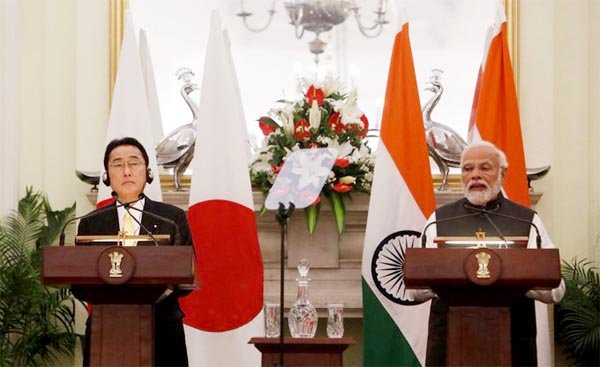
New Delhi, Aug 28 (UNI) Prime Minister Narendra Modi’s visit to Japan tomorrow to attend the 15th annual India-Japan Summit will pave the way for further strengthening the Special Strategic and Global Partnership between the two democracies.
This visit is particularly significant as Japan has announced plans to invest an impressive USD 68 billion over the next decade to boost bilateral business relations with India. During the summit, both nations are expected to elevate their defence cooperation and discuss key areas of economic security, including emerging technologies such as semiconductors, Artificial Intelligence (AI), and critical minerals.
This will be Prime Minister Modi’s first meeting with the newly elected Japanese Prime Minister Shigeru Ishiba, marking an important chapter in India-Japan relations. It will also be Modi’s eighth visit to Japan, underscoring the enduring leadership-level diplomacy between the two countries.
India is in urgent need of rare earth minerals and advanced AI capabilities to secure its technological and economic future, particularly as the rest of the world progresses rapidly in these areas. Rare earths are vital for manufacturing advanced electronics and clean energy technologies, while AI is a cornerstone of modern innovation.
To prevent technological dependence and achieve its strategic goals, India is actively implementing multifaceted strategies to strengthen its position in both fields.
The timing of the visit is especially crucial for India, which has been working to expand its global outreach in response to recent unilateral US tariffs. The summit is seen as an opportunity for both countries to deepen their collaboration in areas that drive economic security, technological innovation, clean energy and people-centric development.
With growing cooperation across a variety of sectors — ranging from defence and infrastructure to space and technology —the India-Japan Special Strategic and Global Partnership is continuously increasing in importance, fostering regional stability, economic growth and innovation.
India and Japan have shared this partnership since 2014, built on deep civilisational ties and a common vision for regional and global issues. Both nations’ approaches to the Indo-Pacific — India’s Act East Policy and Indo-Pacific Oceans Initiative (IPOI) and Japan’s Free and Open Indo-Pacific (FOIP) —align closely, further strengthening cooperation across a range of areas.
This collaboration encompasses enhancing connectivity and infrastructure through initiatives like the Asia-Africa Growth Corridor (AAGC) and supporting the Indo-Pacific Oceans Initiative (IPOI), as well as coordinating the Quadrilateral Security Dialogue (Quad). Key areas of cooperation include economic development and supply chain resilience.
During the summit, Prime Ministers Modi and Ishiba are expected to discuss ways to further enhance their economic ties, particularly in securing stable supply chains for critical goods. A new framework is expected to be signed, focusing on emerging technologies such as semiconductors, AI and pharmaceuticals.
In addition to the summit, Prime Minister Modi is slated to visit Sendai, a city in Northeast Japan renowned for its cutting-edge semiconductor research and development.
The visit also highlights India’s growing interest in strengthening technology ties with Japan. Modi is also expected to invite Prime Minister Ishiba to an international AI conference in India scheduled for February next year. Both leaders will explore opportunities for global cooperation in shaping international rules to govern AI development, ensuring the technology remains safe, ethical and trustworthy.
Beyond technology and economic collaboration, both sides will deliberate on key regional issues such as Indo-Pacific security, climate change, and economic stability.
Japan, being a crucial player in the G7 and Quad, plays an important role in supporting India’s push for a rules-based order in the Indo-Pacific.
India and Japan’s cooperation extends beyond bilateral discussions into several multilateral platforms, including the Quad, the International Solar Alliance (ISA), the Coalition for Disaster Resilient Infrastructure (CDRI), and the Supply Chain Resilience Initiative (SCRI). Japan remains a crucial partner in the IPOI’s connectivity pillar and continues to be India’s largest official development assistance (ODA) donor, supporting a wide range of critical infrastructure projects.
Bilateral trade between India and Japan reached USD 22.8 billion in 2023–24. India imports machinery, steel, reactors, and copper from Japan, while it exports chemicals, vehicles, aluminium, and seafood. Japan is India’s fifth-largest source of Foreign Direct Investment (FDI), with cumulative investments amounting to USD 43.2 billion by December 2024.
The presence of over 1,400 Japanese companies operating across nearly 5,000 establishments in India further underscores the strength of the two nations’ economic ties. Emerging areas for collaboration include digital cooperation, clean energy, industrial competitiveness and supply chain resilience.
Japan has been a key ODA partner to India since 1958, supporting a range of important infrastructure and development projects. One of the most iconic collaborations is the Mumbai–Ahmedabad High-Speed Rail (Shinkansen) project, which stands as a symbol of advanced technology transfer and skill development.
Japan has also supported the development of metros, industrial corridors, renewable energy, and urban infrastructure, with JPY 580 billion (USD 4.5 billion) in ODA disbursements during 2023–24.
On the multilateral front, India and Japan are committed to promoting a free and open Indo-Pacific, with both countries working together in the Quad alongside the US and Australia. Their cooperation under the Supply Chain Resilience Initiative further strengthens the diversification and security of global supply chains. Their leadership during the 2023 G20 presidencies also showcased their growing alignment on issues of global importance, especially concerning the Global South.
In the realm of science and technology, India and Japan are advancing an ambitious agenda to deepen their collaboration in space exploration, satellite navigation, and agricultural monitoring.
The India-Japan Year of Science, Technology, and Innovation Exchanges (2025–26) will serve as a major platform to deepen cooperation in these fields. India’s Space Research Organisation (ISRO) and Japan’s Aerospace Exploration Agency (JAXA) are already collaborating on lunar exploration, Space Situational Awareness (SSA), and other critical space technologies. The launch of the IIT Bombay–Tohoku Joint Institute of Excellence in April 2025 further strengthens academic and research ties, ensuring continued progress in scientific innovation.