

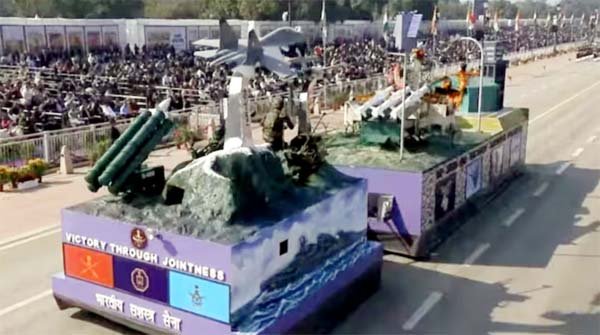
New Delhi, Jan 26 (UNI) The 77th Republic Day Parade on Kartavya Path on Monday presented a meticulously choreographed and operationally realistic display of India’s military strength, technological transformation and jointmanship, with the defence forces showcasing its mounted, mechanised and marching contingents.
The Battle Array Formation, showcased for the first time on Kartavya Path, marked a significant shift from a purely ceremonial presentation to a combat-ready battlefield layout, reflecting the Army’s evolving doctrine aligned with modern, multi-domain warfare.
The celebrations commenced with an aerial opening as the Dhwaj Formation soared over Rashtrapati Bhavan. Four Mi-17 IV helicopters from the 129 Helicopter Unit flew in an inverted ‘Y’ formation, carrying the National Ensign along with the flags of the Indian Army, Navy and Air Force.
Group Captain Alok Ahlawat led the formation carrying the National Flag, while Wing Commander Ashutosh Khanduri carried the Army Ensign. Wing Commanders Abhishek Malhotra and Abhishek Shukla flanked the formation, bearing the Navy and Air Force Ensigns respectively.
The parade was led by Parade Commander Lieutenant General Bhavnish Kumar, General Officer Commanding, Delhi Area, accompanied by Deputy Parade Commander Major General Navraj Dhillon, Chief of Staff, Headquarters Delhi Area.
Immediately following the Parade Commander were the nation’s most decorated heroes, recipients of India’s highest gallantry awards. The Param Vir Chakra awardees present were Subedar Major (Honorary Captain) Yogendra Singh Yadav (Retd) and Subedar Major Sanjay Kumar, while Ashok Chakra awardees included Major General C.A. Pithawalia (Retd) and Colonel D. Sreeram Kumar.
The mounted column opened with the iconic 61st Cavalry, the world’s only active horse cavalry regiment, bearing its proud motto ‘Ashva Shakti Yashobal’ (Horse Power Forever Supreme). Commanded by Captain Ahaan Kumar, the contingent, was mounted on immaculate steeds.
The mounted display transitioned into modern reconnaissance and aviation assets with the High Mobility Reconnaissance Vehicle (HMRV) leading the column. India’s first indigenously designed armoured light specialist vehicle demonstrated enhanced mobility and survivability for forward reconnaissance
This was followed by Army Aviation platforms, including the ALH Dhruv, Rudra, Prachand and Apache AH-64E, accentuating deepening air-ground combat integration and precision strike capability.
Spearheading the mechanised column was the T-90 Bhishma main battle tank, commanded by Captain Vipanjot Singh Virk, showcasing its Hunter-Killer capability and battlefield dominance. It was followed by the indigenous Arjun Mk-I main battle tank, led by Major Hitesh Mehta.
Next in sequence was the BMP-II Infantry Combat Vehicle, marching with the motto ‘Pehla Hamesha Pehla’ and commanded by Captain Akshay Kumar Bali. The platform showcased mechanised infantry superiority integrated with advanced ISR drones and loitering munitions for real-time situational awareness.
The mechanised thrust continued with NAMIS-II, the third-generation fire-and-forget anti-tank missile system, led by Lieutenant Shashank Sharma. Advancing with the war cry ‘Satrah Mech – Har Maidan Fateh’, the system demonstrated autonomous targeting and precision lethality against armoured threats.
Elite Special Forces followed, mounted on Ajayketu All-Terrain Vehicles, Randhwaj tactical transporters and Dhawanshak Light Strike Vehicles. Robotic dogs, unmanned ground vehicles and autonomous systems presented a striking visual.
The Regiment of Artillery made a powerful mechanised statement with its war cry ‘Second to None’. Led by Lieutenant Raman Mishra and Subedar Kiran Medar, the Artillery showcased unmanned warhead systems Shantibaan and Divyastra, along with swarm drones and long-range precision strike capabilities. Indigenous artillery platforms Dhanush, ATAGS (Amogh) and the Suryastra Universal Rocket Launcher System followed.
Strategic deterrence and layered air defence were represented by the BrahMos missile system and Akash and ABHRA (MRSAM) missile systems. The mechanised column also included Drone Shakti and the Integrated Operational Centre, depicting the success of Operation Sindoor and highlighting joint operational synergy, leadership and network-centric warfare.
A unique highlight was the debut of the Remount and Veterinary Corps (RVC) contingent led by Captain Harshita Raghav. The contingent showcased animals supporting soldiers in extreme terrain, guided by the principle of Vasudhaiva Kutumbakam. Bactrian camels from the cold deserts of Ladakh, Zanskari ponies from the icy heights of Siachen, indigenous Army dogs, Mudhol Hound, Rampur Hound, Chippiparai, Kombai and Rajapalayam, and Black Kites used for surveillance and anti-drone roles.
The marching contingents began with the Mixed Scouts Contingent, led by Lieutenant Amit Choudhary of 2 Arunachal Scouts. Comprising personnel from Sikkim Scouts, Arunachal Scouts, Kumaon Scouts, Ladakh Scouts, Garhwal Scouts and Dogra Scouts, the contingent represented elite high-altitude infantry units specialised in frontier surveillance and reconnaissance, marching with the ethos ‘Service Before Self’.
They were followed by the Combined Military Band of the Parachute Regiment, Brigade of the Guards and Rajputana Rifles, led by Subedar Major Prakash Chandra Joshi, playing the iconic ‘Vande Mataram’.
Subsequent contingents included the Rajput Regiment, led by Lieutenant Vikas Khatri of 21 Rajput, marching with the war cry ‘Rajput – Second to None’, the Assam Regiment, commanded by Captain Aryan Deolekar of 6 Assam, the Jammu and Kashmir Light Infantry, led by Captain Vedant Sethi; the Regiment of Artillery, commanded by Captain Gajendra Goswami, and the debutant 4 Bhairav Battalion of the Sikh Light Infantry, led by Major Anjum Gorka, raising the battle cry ‘Jo Bole So Nihal, Sat Sri Akal’.
The Indian Navy contingent, led by Lieutenant Karan Nagyal, marched to the tune of ‘Jai Bharati’, followed by the Navy tableau themed ‘Anchored in Tradition, Sailing into Self-Reliance and Innovation’.
The Indian Air Force marching contingent, led by Squadron Leader Jagdesh Kumar, was followed by the Sindoor Formation fly-past comprising Rafale, MiG-29, Su-30 and Jaguar aircraft.
Marching contingents of the Indian Coast Guard, Central Industrial Security Force, Central Reserve Police Force, Indo-Tibetan Border Police, Delhi Police and the BSF Camel Contingent followed, highlighting operational readiness across maritime security, internal security and border guarding roles.
The parade concluded with youth and civil contingents, including the National Cadet Corps (Girls and Boys), MY BHARAT–National Service Scheme, and the Massed Pipes and Drums Band of the Indian Army.